
Music of Germany: from church choirs to robot pop
Germany is home to centuries of choirs, church organs and famous composers. It is also where a band called Kraftwerk built pop songs out of electronic machines.
In this lesson
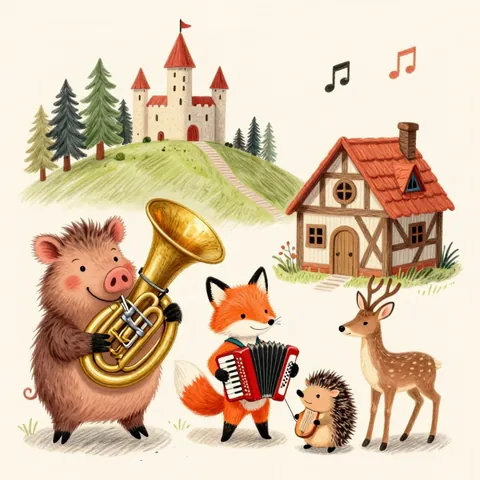
What does German music sound like?
There is no single German sound. Long ago, people sang love songs in the castles and hymns in the churches. Later, great composers wrote symphonies, piano pieces and songs for one singer with a piano.
Folk music has its own flavor too. In Austria and the nearby Alps, people danced the Ländler, a dance in three beats per bar with a strong first beat. It is a country cousin of the waltz, which also counts in three: ONE-two-three, ONE-two-three.
In recent times, Germany became famous for electronic music. In the 1970s, a band named Kraftwerk used synthesizers and drum machines to make songs that sounded like the future.
Chorales, counterpoint and fugue
Martin Luther wanted everyone in church to sing in German, and the first hymnbooks of this kind came out in 1524. These hymns are called chorales.
Bach set hundreds of chorale tunes for four voices: soprano, alto, tenor and bass. About 370 of them were printed after his death, and many music students still use them to learn how chords move.
Bach was also a master of counterpoint: several melodies at once, each one making sense on its own. In a fugue, one voice plays a short tune called the subject, then other voices copy it, starting on different notes, one after another.
His Well-Tempered Clavier has two books, each with 24 preludes and fugues, one for every major and minor key.
The story of one song
In 1974, the band Kraftwerk made a record about a drive on a German motorway. The song is called Autobahn, and the word means motorway.
The band had its own studio in Düsseldorf, called Kling Klang, and finished the record in the studio of the producer Conny Plank. They used synthesizers, drum machines and electronic drums they built themselves. You can hear engine and road sounds in the music.
A short version of the song, about three minutes long, became a hit in 1975. The band helped set the pattern for the electronic music that came later.
Instruments and sounds of Germany
Here are some instruments with a German story. Many of them travelled far beyond Germany.
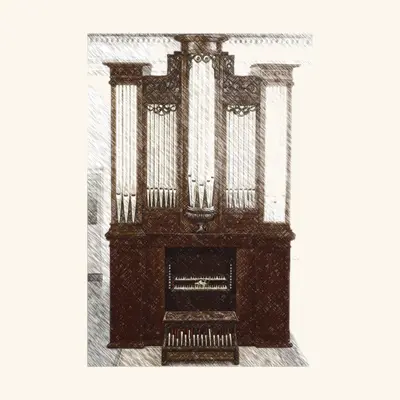 Pipe organ
A giant keyboard instrument that pushes air through pipes, and Germany has a long tradition of building them, with makers such as Arp Schnitger and Gottfried Silbermann.
How it is built: Many pipes of different sizes stand in rows. Pressing a key lets air flow into a pipe, and the air makes it sing like a giant whistle or, in reed pipes, a buzzing reed.
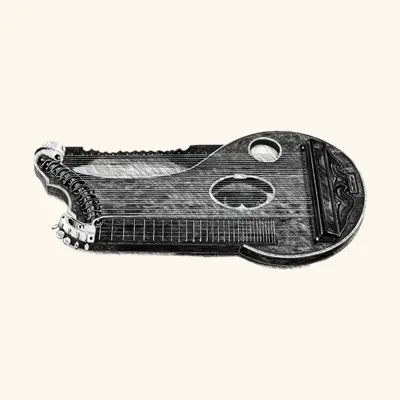 Zither
A flat instrument with about 30 or more strings, played in the Alps: the left hand presses the melody strings and the right hand plucks them with a small pick.
How it is built: The flat wooden body is a hollow sound box. A few melody strings run over a fretted fingerboard, and many more strings lie loose beside it for chords and bass.
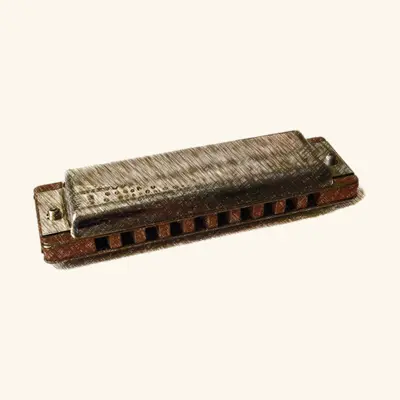 Harmonica
A little mouth organ where each breath makes thin metal reeds buzz, and the German clockmaker Matthias Hohner started his harmonica company in Trossingen in 1857.
How it is built: Inside a row of small air chambers sit two thin metal reeds, one for blowing and one for sucking. Air makes a reed vibrate back and forth, and that buzz is the sound.
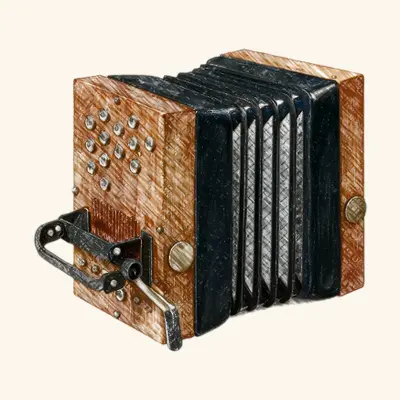 German concertina
A small squeezebox with buttons on both ends, introduced by Carl Friedrich Uhlig in 1834, which makes sound as you push and pull the bellows.
How it is built: A flat wooden end plate sits at each side of a pleated paper bellows. Pushing or pulling the bellows sends air over metal reeds, and each button can play a different note on push and pull.
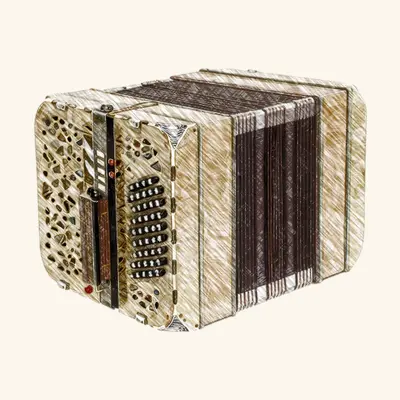 Bandoneon
A squeezebox named after the German instrument dealer Heinrich Band in the mid-1800s, partly meant for church music, but later a star of Argentine tango.
How it is built: Square wooden ends with many buttons are joined by a pleated bellows. Air from the bellows flows over small metal reeds, and a button often plays two different notes on push and pull.
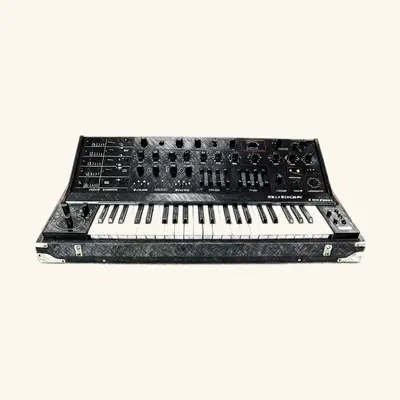 Synthesizer
An electronic keyboard that makes sounds with electricity, and the band Kraftwerk used synthesizers, drum machines and a vocoder to make its music.
How it is built: A synthesizer starts with an electronic buzz, then filters and shapes it with knobs and sliders. A keyboard chooses the pitch, and speakers turn the signal into sound.
Each picture is either a picture-book drawing or a simple diagram, not a photo. Small details are simplified.
Symphonies, sonata form and the Lied
A symphony is a long piece for orchestra, usually in several parts called movements. The first movement is often in sonata form: the themes are presented, then taken apart and developed, then brought back.
Composers of the German-speaking world, such as Haydn, Mozart and Beethoven, made this plan famous. The name sonata form came later, between the 1820s and the 1840s, and the writer Adolf Bernhard Marx helped make it popular.
A song for one singer and piano, usually set to a German poem, is called a Lied (plural Lieder). Schubert wrote over 600 songs, including Erlkönig.
How to listen
German music often has a clear plan. Listen for the beat first, then for how the melody and the accompaniment share the work.
- Listen for the three-beat swing
- The Ländler and the waltz both count in three, with a strong first beat: ONE-two-three.
- Listen for a galloping horse
- In Schubert's song Erlkönig, which he wrote at age 18, the piano plays fast repeating notes that sound like a horse running.
- Listen for robot patterns
- Kraftwerk built its songs from short, repeating rhythms, and used a vocoder to make voices sound like robots.
Set the metronome to three beats per bar. Clap hard on beat one and softly on two and three. Now try to take a big step on beat one like a Ländler dancer.
Listen: several voices at once
A lot of German church and concert music is built from several lines at the same time, not just one tune with a simple backing. In a four-part chorale like the ones described on this page, the tune sits on top and three lower voices move along with it, so you hear a new chord under the melody again and again, like a group of people walking in step.
Counterpoint works the other way round. Instead of moving together, the voices take turns: one plays a short tune, then another copies it on a lower note while the first one carries on with something new. Your ears switch back and forth, a bit like following two friends who are talking at once.
- The first line of Luther's hymn Ein feste Burg (about 1529) in four voices: the tune on top, three voices below.
- A short tune in the right hand, then the left hand copies it two octaves lower while the right hand plays a new line.
A chorale is sung by a choir; here the four voices are played on piano, in even beats. The harmony and the copying tune were written for this page.
Big moments in the story of German music
- About 1100sHildegard of Bingen
A nun and abbess named Hildegard, who lived from about 1098 to 1179, wrote songs with soaring melodies, and dozens of her songs, plus a sung play, still survive.
- 1100s to 1300sMinnesang
Poet-singers wrote love songs in German, and Walther von der Vogelweide, who lived from about 1170 to about 1230, is one of the best known.
- 1212A boys' choir begins
The Thomanerchor of Leipzig was founded in 1212, and boys still sing in it today.
- About 1529A hymn for everyone
Martin Luther wrote the words and the tune of the hymn Ein feste Burg around 1527 to 1529, so people could sing together in German.
- 1723Bach in Leipzig
Johann Sebastian Bach became the music director of the churches in Leipzig, where he wrote and led music for about 27 years.
- 1824Beethoven's Ninth
On 7 May 1824, Beethoven's Ninth Symphony was first played in Vienna, and it was one of the first big symphonies by a famous composer to include singers.
- 1876A theatre for one composer
Richard Wagner's festival theatre in Bayreuth opened, and the four operas of The Ring of the Nibelung were performed there together for the first time.
- 1974Kraftwerk's Autobahn
Kraftwerk, a band formed in Düsseldorf in 1970, released Autobahn, a record about driving whose title song lasts nearly 23 minutes.
Names to look up
These are only examples, not a ranking. Search for their names to listen to their music.
- Hildegard of Bingen
- Johann Sebastian Bach
- Ludwig van Beethoven
- Clara Schumann
- Fanny Hensel
- Johannes Brahms
- Anne-Sophie Mutter
- Kraftwerk
- Nena
- Hans Zimmer
Meanwhile, around the world
While these things happened in German music, here is what else was going on in other places.
- 1215Magna Carta in England
In the time of the Minnesang poets, King John of England put his seal on the Magna Carta, an important agreement, at Runnymede.
- 1543The Sun at the center
About 14 years after Luther's hymn, Copernicus published his idea that the planets travel around the Sun.
- 1725Vivaldi's Four Seasons
Two years after Bach arrived in Leipzig, the Italian composer Vivaldi's four violin concertos about the seasons were published in Amsterdam.
- 1825A steam railway opens
A year after Beethoven's Ninth, the first public railway pulled by steam locomotives opened in England.
- 1876The first telephone call
In the year the Bayreuth theatre opened, Alexander Graham Bell made the first successful telephone call.
- 1977Music flies into space
A few years after Autobahn, the Voyager spacecraft left Earth carrying a golden record with music by Bach and Beethoven.
Hear the styles on this page
- Listen for machine-like patterns that repeat exactly, with clean electronic tones instead of real instruments.
How this page was checked: each fact was looked up again in the sources below — encyclopedias, museums, universities, cultural institutions and makers. Wikipedia was used only as a pointer, never as a source. It has not been reviewed by an outside music expert; if you spot a mistake, please tell us at support@sunsunlabs.com.
- UNESCO Intangible Cultural Heritage – Organ craftsmanship and music (Germany)
- Thomaskirche Leipzig – Thomanerchor und Thomaskantor
- Bayreuther Festspiele – History
- Beethoven-Haus Bonn – 200 years of the Ninth Symphony
- MusicRadar – A music professor breaks down the theory behind Kraftwerk's Autobahn
- Rolling Stone – Kraftwerk play 1974's Autobahn (single edit reached No. 25 in 1975)
- Classic FM – Ludwig van Beethoven: biography and facts
- Deutsche Biographie – Walther von der Vogelweide
- Oxford German Network (University of Oxford) – Pop-Poesie: Minnesang
- Rutgers University WAM! – Hildegard of Bingen: interview with Dr. Margot Fassler
- Hymnary.org – Ein' feste Burg ist unser Gott
- Lutheran World Federation – Germany: Spreading faith through song (1524 Erfurt Enchiridion)
- Bach Cantatas Website – History of the Breitkopf collection of Bach's four-part chorales
- British Library – Add MS 35021, Well-Tempered Clavier Book II
- Hepokoski & Darcy, Elements of Sonata Theory (Oxford University Press) – Sonata form as a whole
- University of Wisconsin–Madison – The Erlkönig Project
- University of Edinburgh St Cecilia's Hall – Hohner harmonica (firm founded 1857 by clockmaker Matthias Hohner)
- Horniman Museum – Salzburg zither by J. Sandher, Laupheim
- Chemnitz 2025 European Capital of Culture – Bandoneon exhibition (Uhlig 1834, Heinrich Band)
- Hyperion Records – Bruckner Symphony No 4 notes (Ländler, "country cousin" of the waltz)
Piano sound: Salamander Grand Piano by Alexander Holm (CC BY 3.0).