
Music of Mexico: from Aztec drums to mariachi trumpets
Mexican music grew from many roads: the drums and whistles of the Aztec age, the guitars and violins that came from Spain, and the brass bands and accordions of later years. Each region of the country has its own sound, and you can hear the mix in every song.
In this lesson
What Mexican music sounds like
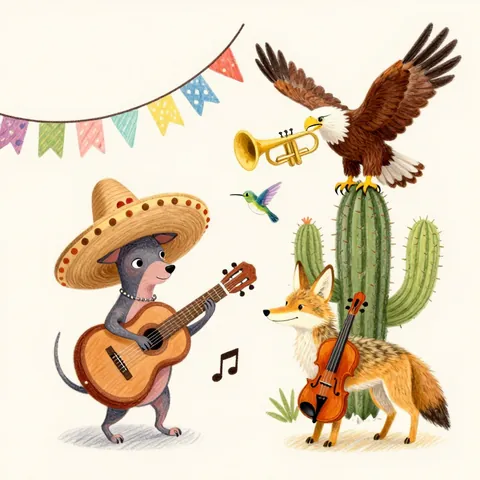
Imagine a party in the town square. Trumpets sing high, guitars strum a bouncy beat, and people clap and dance. That is the sound many people picture when they think of Mexico.
But there is much more. In Veracruz, players trade verses over harps and small guitars. In the north, an accordion plays a dance tune. In the old Aztec lands, drums were played for ceremonies long before any guitar arrived.
Sesquialtera: two ways to count six
Many Mexican sones mix two ways of counting six: 1-2-3, 4-5-6 (two groups of three, as in 6/8) and 1-2, 3-4, 5-6 (three groups of two, as in 3/4). This mix of 3/4 and 6/8 is called sesquialtera.
It makes the beat feel like it is rocking back and forth. It is one of the things that make son sound so lively. Not every son uses it, though.
Set the metronome to a medium speed and count to six on the clicks. Clap ONE two three FOUR five six, then ONE two THREE four FIVE six, and keep switching.
The story of one song: La Bamba
La Bamba is a traditional folk song from Veracruz, on Mexico's eastern coast. It belongs to son jarocho, a style that mixes Spanish, Indigenous and African music.
Long ago it was sung at weddings. Dancers stamped quick steps together, and guests could add new verses just for the happy couple. Players on harp, jarana and requinto kept the song bouncing along.
Nobody is sure what the word "bamba" means. In 1958, a young American singer, Ritchie Valens, made a rock and roll version that many people still know today.
Traditional instruments
Here are some instruments you can look up and listen to.
 Huehuetl
An upright wooden drum with a skin on top, played with the hands or sticks, used by the Aztecs and neighbouring peoples.
How it is built: The body is a hollowed tree trunk, open at the bottom and standing on three legs carved from its base. An animal skin is stretched over the top to be hit.
 Teponaztli
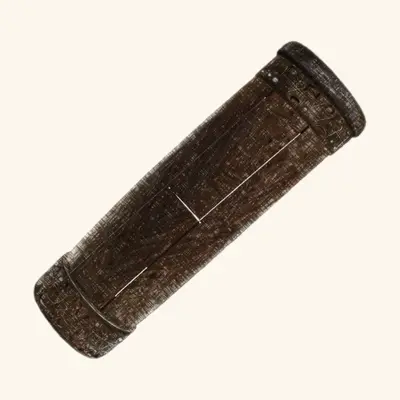
A hollow log drum with an H-shaped cut on top; you hit the two wooden tongues with mallets to get two different notes.
How it is built: It is a hollowed hardwood log with an H-shaped cut on top. The cut makes two wooden tongues of different thickness, so they sound two different notes.
 Clay whistles, ocarinas and conch shells
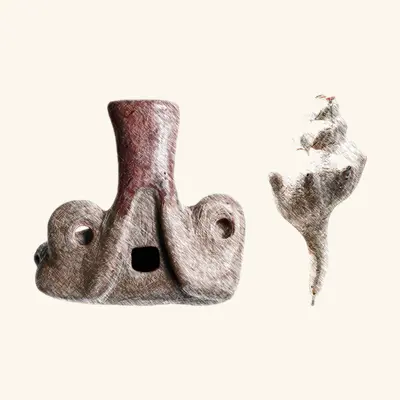
Old Mexican peoples made whistles and ocarinas from clay and blew big conch shells like trumpets.
How it is built: Clay ocarinas are hollow chambers with a mouthpiece and finger holes; air hits an inner edge and the chamber hums. A conch is blown through its cut tip with buzzing lips.
 Jarana jarocha
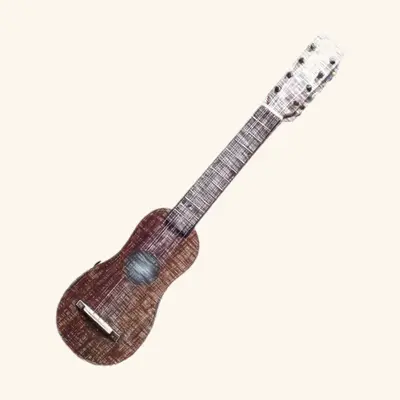
A small, strummed guitar-like instrument from Veracruz that keeps the beat in son jarocho.
How it is built: The body is carved from one block of wood, hollowed out, then topped with a flat soundboard. It has 8 strings in 5 groups, with the outer strings single and the middle ones paired.
 Huapanguera
A big, deep-voiced guitar with five groups of strings, played in the Huasteca region together with a violin and a jarana.
How it is built: It has a big, deep body, so the sound is low. Its strings are set in 5 groups, and the extra-large body helps it act as the bass.
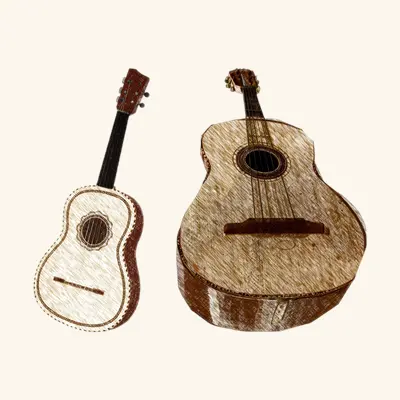 Vihuela and guitarrón
In a mariachi band, the round-backed vihuela strums the rhythm and the big guitarrón plays the low bass notes.
How it is built: Both have deep bodies. The small vihuela has 5 strings and a rounded back; the huge guitarrón has 6 thick strings and no frets, so it booms like a bass.
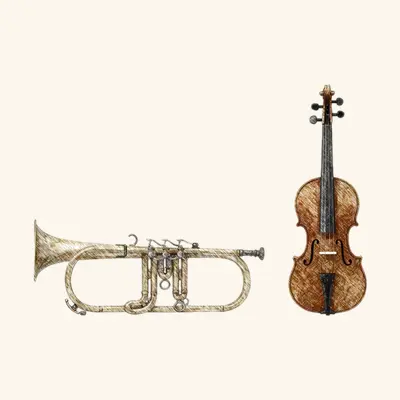 Trumpet and violin
These two are the bright voices of a mariachi, playing the tunes that singers follow.
How it is built: A trumpet is bent brass tubing with a bell and three valves; buzzing lips in the mouthpiece make the sound. A violin has four strings over a hollow wooden body, rubbed by a bow.
 Button accordion and bajo sexto
In norteño music, the small accordion plays the tune while the bajo sexto, a big twelve-string guitar, plays the beat and bass.
How it is built: The button accordion pushes air with folding bellows past small metal reeds; each button gives one note pushing and another pulling. The bajo sexto is a deep guitar with 12 strings in 6 pairs.
Each picture is either a picture-book drawing or a simple diagram, not a photo. Small details are simplified.
Son jarocho: verses and the tarima
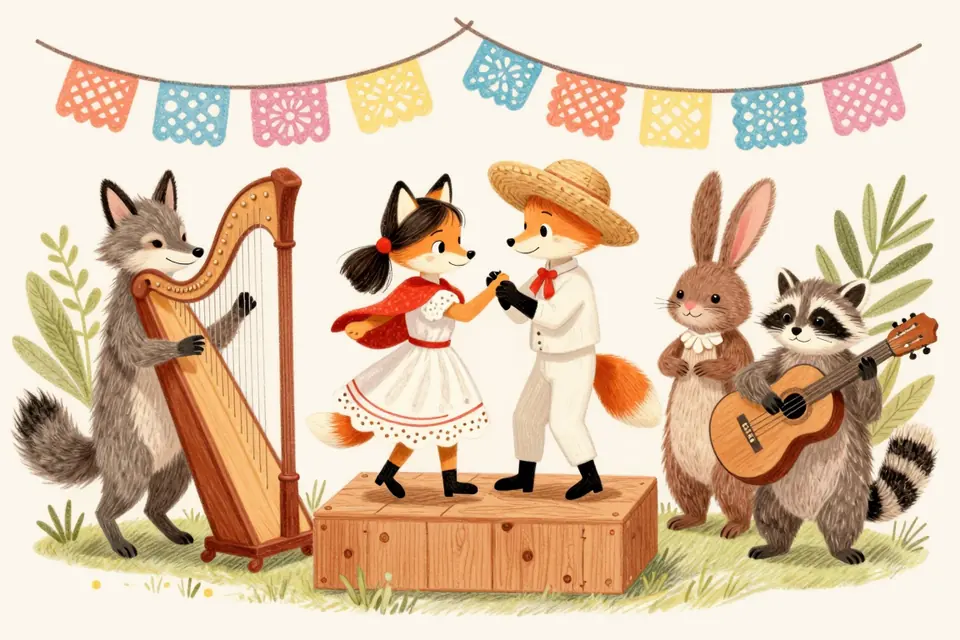
In son jarocho from Veracruz, singers trade verses called décimas, often made up on the spot. The lead singer, called the pregonero, often makes up new verses.
Dancers tap their heels on a wooden platform called a tarima. The tarima counts as a percussion instrument, so the dancers' feet become part of the band.
How to listen
Mexican music has many styles, so listen for how the beat moves. Some songs sway, some bounce, and some stop for a happy shout. Pick one song and notice what the instruments do.
- Listen for the shout
- In rancheras, singers often let out a big yell, called a grito, to show strong feelings.
- Listen for 3 and 6 mixing
- Mariachi songs in the son style swing between a count of three and a count of six, so the beat feels like it is rocking.
- Listen for the bounce
- Norteño music from the north often has a polka-like bounce, with the accordion on the tune and the bajo sexto on the beat.
Set the Sowlea metronome to a medium speed and clap on every click. First count 1-2-3, 1-2-3 for a swaying feel, then count 1-2, 1-2 for a bouncing feel. Then listen to one ranchera and one norteño song and guess which count each one is closer to.
Listen: why it sounds different
Much of the rocking feel in Mexican son comes from sesquialtera (see its own section): the same six counts are grouped 3+3, then 2+2+2. In the demo, the strummed chords switch between "one-two-three, four-five-six" and "one-two, three-four, five-six", so the beat seems to sway back and forth even though the speed never changes.
Music from the north sounds different again. In the 1800s, immigrants from places such as Germany, Poland and Bohemia (today's Czech Republic) brought the polka and the accordion, and norteño grew from that mix. Its beat is a simple "oom-pah" in two: a low bass note, then an off-beat chord, like a cheerful step-hop.
- Six counts grouped 3+3, then 2+2+2: hear the beat rock.
- A bouncy "oom-pah" beat in two, with an accordion-style tune.
In real bands the rhythm comes from strummed vihuelas and guitars, or from an accordion and a bajo sexto; here the piano plays every part.
Big moments in the story of Mexican music
- 1325 (traditional date)Tenochtitlan begins
According to tradition, the Aztec capital was founded on an island in a lake in 1325, and drums like the huehuetl and teponaztli were played there.
- 1521Old and new meet
After the Spanish took Tenochtitlan, Spanish instruments like guitars and violins began to mix with local ones, starting new kinds of music.
- 1600s–1700sSon jarocho takes shape
In Veracruz, Spanish, African and local music blended over time into a lively style of songs and dances.
- 1800sBrass bands arrive
From the middle of the century, valved brass instruments reached Mexico and town bands began to play; in Sinaloa this grew into the banda with its tuba and tambora drum.
- Early 1900sRanchera and corrido
Ranchera songs about love, home and the countryside grew popular around the time of the Mexican Revolution, and corridos told stories in song.
- 1930sTrumpets join the mariachi
Trumpets joined some mariachis in the early 1900s; by the 1930s, as mariachi became a stage and radio act, the trumpet was a bright voice of the group.
- 1930s–1950sThe film golden age
Mexican movies were made in great numbers, and singing stars like Jorge Negrete and Pedro Infante helped spread Mexican songs.
- 2011Mariachi honoured
UNESCO added mariachi to its list of the world's intangible cultural heritage.
Names to look up
These are only examples, not a ranking. Search for their names to listen to their music.
- Carlos Chávez
- Pedro Infante
- José Alfredo Jiménez
- Vicente Fernández
- Chavela Vargas
- Juan Gabriel
- Los Tigres del Norte
- Café Tacvba
- Natalia Lafourcade
- Lila Downs
Meanwhile, around the world
Here is what else was going on while Mexican music was growing.
- 1539First printing press in the Americas
A printing press was set up in Mexico City, and printed books began to spread there years after the Spanish arrived.
- 1685Bach is born
In Germany, the composer Johann Sebastian Bach was born; his music is still played everywhere today.
- 1810A church bell rings
On 16 September, a priest named Miguel Hidalgo rang the church bell in the town of Dolores and called for independence, a day Mexico still celebrates.
- 1829The accordion is patented
In Vienna, Cyrill Demian patented an instrument called the accordion; it later became a favourite in places like northern Mexico.
- 1879Danzón is born in Cuba
The danzón, a slow elegant dance, took shape in Cuba, and Miguel Faílde's Las alturas de Simpson was played that year; it later became loved in Mexico, especially in Veracruz and Mexico City.
- 1936A Mexican symphony in Boston
Carlos Chávez conducted his Sinfonía india, built on tunes of native peoples of Mexico, with the Boston Symphony Orchestra.
Hear the styles on this page
- Listen for the even, driving piano notes and the strong snare on beats 2 and 4.
- Listen for the waltz pattern: a low note on beat 1 and chords on beats 2 and 3, under a big, open-hearted tune.
How this page was checked: each fact was looked up again in the sources below — encyclopedias, museums, universities, cultural institutions and makers. Wikipedia was used only as a pointer, never as a source. It has not been reviewed by an outside music expert; if you spot a mistake, please tell us at support@sunsunlabs.com.
- UNESCO Intangible Cultural Heritage – Mariachi, string music, song and trumpet (2011)
- Britannica – Mariachi
- Britannica – Latin American music: Pre-Columbian patterns
- Britannica – Latin American music: Folk and popular music
- The Met – Drum (Teponaztli), Mexica (Aztec)
- Britannica – Teponaztli
- Wired Humanities (Univ. of Oregon), Visual Lexicon of Aztec Hieroglyphs – huehuetl
- The Met – Pottery Whistle, Mexico
- University of Edinburgh, St Cecilia's Hall – Jarana jarocha
- Smithsonian Folkways – Son Jarocho from Veracruz: Exploration of Music and Dance Forms
- Smithsonian Folkways – Los Camperos de Valles demonstrate son huasteco
- Britannica – Tejano (norteño, accordion, bajo sexto)
- Britannica – Accordion
- NPR Alt.Latino – Regional Goes Global, Part 3 (banda history)
- NPR World Cafe – Latin Roots: Ranchera
- Library of Congress, Now See Hear! – La Bamba
- Indiana University Cook Music Library – Sounds of Mexico: La Bamba
- Britannica – Tenochtitlan
- Britannica – Grito de Dolores
- Britannica – Sinfonía india
Piano sound: Salamander Grand Piano by Alexander Holm (CC BY 3.0).