
Music of India: ragas, drums and songs from the movies
Music in India is very old, and it is still part of weddings, festivals, temples and movies today. Let's explore the big ideas, the instruments and the songs.
In this lesson
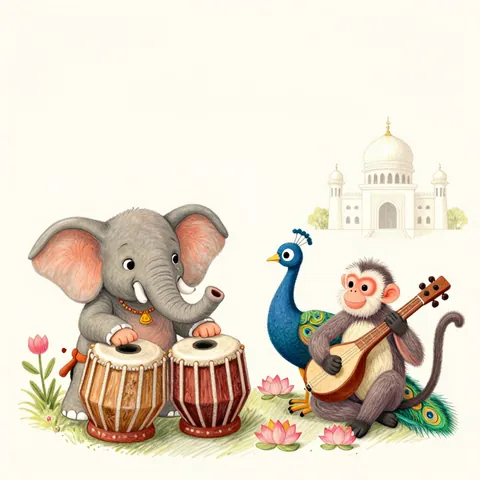
What does Indian music sound like?
Imagine a singer or a sitar starting very slowly, with a steady humming sound underneath. Then the tune stretches, bends and slowly wakes up, and the drums join in.
Two ideas hold much of this music together: a raga, which is like a set of notes with its own mood, and a tala, which is a repeating rhythm pattern. A musician can make up lots of new ideas inside these two frames.
The story of a singer and the rain
Long ago, a singer named Tansen worked in the court of Emperor Akbar. He lived in the 1500s and is one of the best-known names in North Indian music.
Many stories say Tansen could change the world with a raga. One tells how Raga Megh Malhar made rain fall. Another says Raga Deepak, the raga of fire, made the air so hot that flames burst out.
Careful readers think these tales are probably legends. Still, they show how people feel about ragas: each one has a mood, and some are linked to rain, evening or morning.
Raga and tala, made simple
A raga is like a box of colors for a tune. It tells the musician which notes to use and gives the music a feeling, such as calm, joyful or sleepy. The word comes from an old word that means "to color", as in coloring the mind. Long ago, ragas were matched with times of day and seasons, and some musicians still do this.
A tala is a rhythm cycle, like a clock that keeps going around. One famous tala, called teental, has 16 beats split into four groups of four. Listeners clap on some beats and wave a hand on one "empty" beat. The first beat, called sam, is like home base, and the music loves to land there.
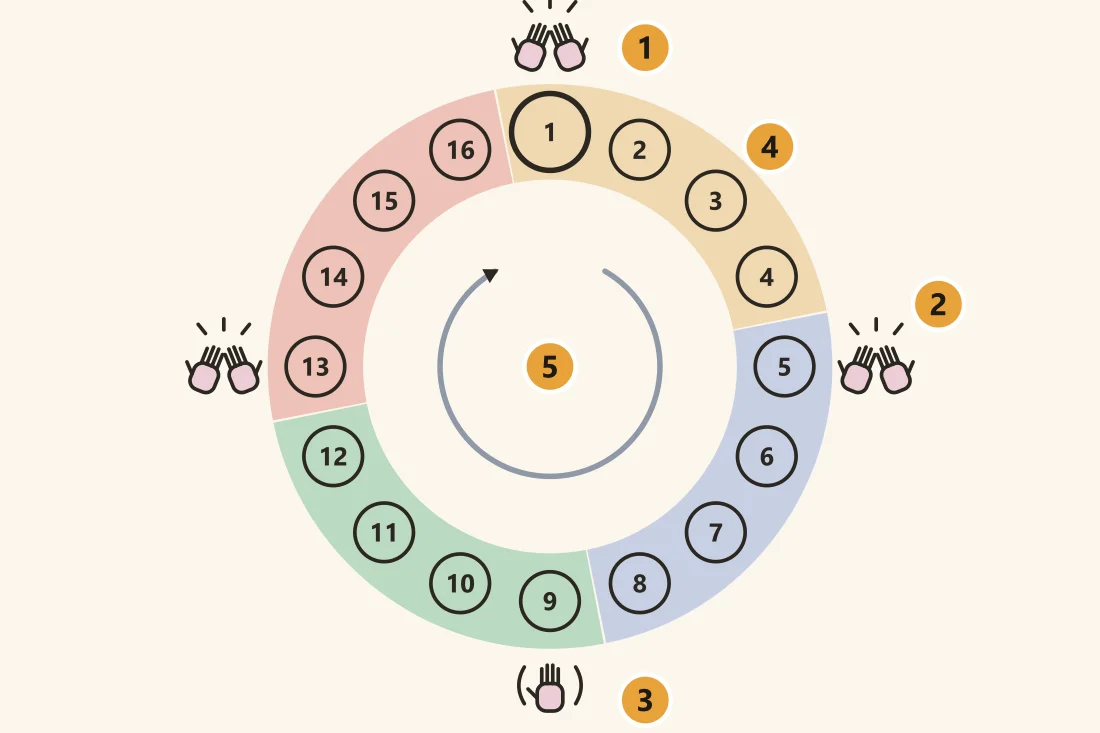
- Beat 1, “sam”: the most important beat, where everyone meets; you clap here
- You also clap on beats 5 and 13
- Beat 9, “khali” (empty): instead of clapping, you wave your hand
- Every 4 beats make a group; 16 beats make 4 groups
- Go round clockwise, again and again
Sa, re, ga, ma: the names of the notes
Indian music names its seven notes sa, re, ga, ma, pa, dha and ni. Together they are called sargam, and they work a lot like Do, Re, Mi.
Sa is the home note of a piece, and a singer can choose any pitch to be sa, like movable Do. The drone keeps that home note sounding underneath.
Sa and pa never change. Re, ga, dha and ni can be sung a half step lower (komal), and ma can be sung a half step higher (tivra). These choices help give each raga its own color.
Sing Do, Re, Mi, Fa, Sol, La, Ti, Do. Then sing the very same notes as sa, re, ga, ma, pa, dha, ni, sa. The tune stays the same; only the names change.
Two big classical traditions
North India is home to Hindustani music. South India is home to Carnatic music. They share ideas like raga and tala, but they feel a little different.
Hindustani music is known for lots of making-up on the spot, and its main drum is the tabla. Carnatic music improvises too, but it also treasures a huge store of set songs called kritis, and its main drum is the mridangam. Neither one is better. They are like two cousins who speak related languages.
Instruments you can look for
Here are some instruments you may hear in Indian music.
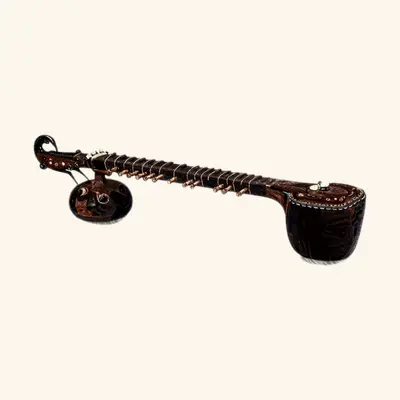 Sitar
A long-necked plucked instrument with movable curved frets, a few main strings to play, and a set of extra strings underneath that hum along by themselves.
How it is built: Its round, hollow body is a dried gourd with a wooden neck. About 6 or 7 main strings run over the curved frets, with 11+ thin strings below; they buzz softly on a wide, curved bridge.
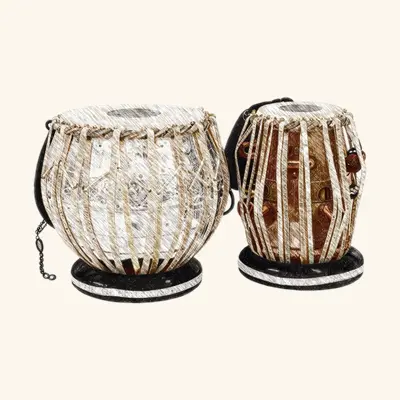 Tabla
A pair of small hand drums with a black paste in the middle of each skin that helps give it its special sound.
How it is built: Two drums, each with one skin stretched over the top and laced tight with leather straps. The small one is wood with tuning blocks; the bigger one is usually copper, though some are wood or clay.
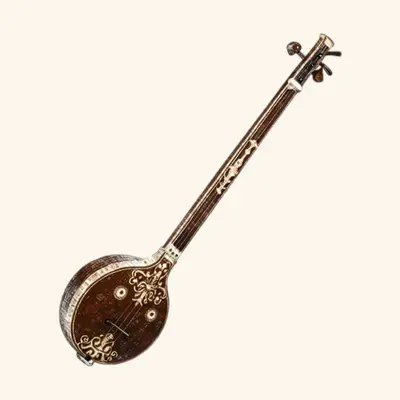 Tanpura
A long instrument with no frets and about four strings, strummed one after another to make a steady drone that the singer or player can lean on.
How it is built: A big round hollow body, often a gourd, with a long wooden neck and flat wooden top. Four strings run over a curved bridge, and each one buzzes as it touches the bridge.
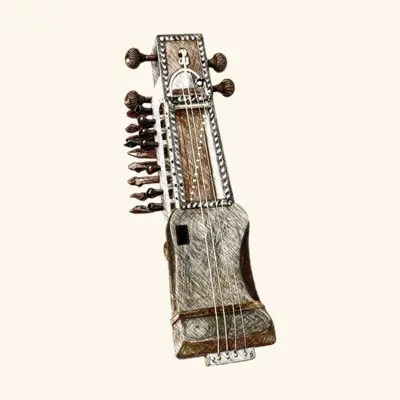 Sarangi
A short-necked fiddle played with a bow, with extra strings that echo, and notes made by pressing the strings with the fingernails and skin of the left hand.
How it is built: The body is carved from one block of wood, with a hollow bowl at the bottom covered with stretched skin. A few thick gut strings are played with a bow, and many thin strings under them ring along.
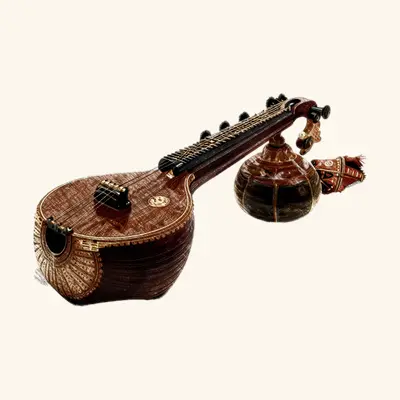 Saraswati veena
A large plucked lute with 24 frets, used mostly in Carnatic music, and named after a goddess of music and learning.
How it is built: A big round bowl carved from jackfruit wood, with a long hollow neck ending in a carved dragon-like head. Four playing strings run over 24 metal frets, with three more on the side.
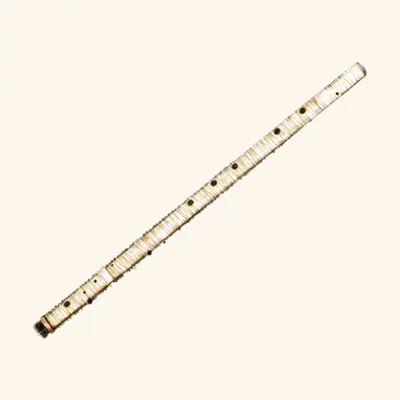 Bansuri
A simple side-blown bamboo flute that sounds airy and soft, and is loved in North Indian music.
How it is built: A hollow bamboo tube with a blowing hole and six or seven finger holes. Blowing across the hole makes the air inside vibrate; covering holes changes the note.
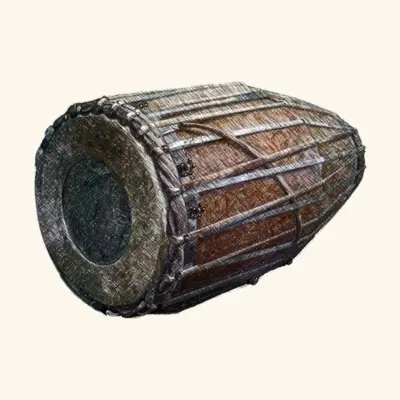 Mridangam
A barrel-shaped drum with two heads, and the main drum in Carnatic music. Both heads are tuned, and the bigger one sounds lower.
How it is built: A hollowed jackfruit-wood body with a skin on each end, joined by long leather straps. The smaller skin has a black spot made from a paste of rice and finely ground stone, which helps it ring clearly.
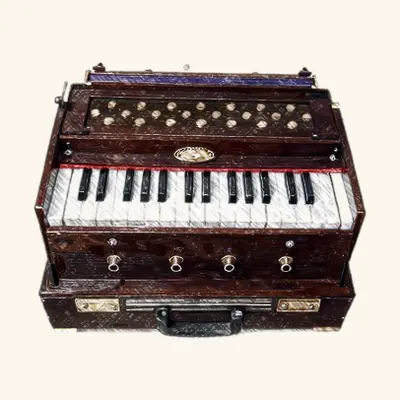 Harmonium
A small keyboard with a hand-pumped bellows, brought to India from Europe in the 1800s and reshaped by Indian makers into a small one played on the floor and now often used for singing and devotional songs.
How it is built: A wooden box with a small keyboard on top. Inside are thin metal strips called reeds, and pumping the bellows pushes air past them so they vibrate and make sound when a key is pressed.
Each picture is either a picture-book drawing or a simple diagram, not a photo. Small details are simplified.
How to listen
Indian classical music often unfolds like a flower opening. Try listening without waiting for a big tune. Notice the steady hum, the slow start and the spoken drum sounds.
- Listen for the drone
- A tanpura plays the same notes again and again underneath, so the singer or player always has a steady home note to return to.
- Listen for the slow start
- Many North Indian pieces begin with an alap, a slow opening with no steady beat, and the pulse and speed build up later.
- Listen for the drum words
- Tabla players learn each stroke as a spoken syllable, such as dha, dhin and na, and can say a rhythm out loud before playing it.
Count slowly from 1 to 16. Clap on beat 1, 5 and 13, and wave your hand on beat 9. Tabla players say these 16 beats as "dha dhin dhin dha, dha dhin dhin dha, dha tin tin ta, na dhin dhin dha". Then try it with the metronome.
Folk songs and songs of devotion
Away from the concert halls, music lives in villages, festivals and prayer. The dhol is a big double-headed drum played with two sticks, and its booming beat makes people dance at weddings and celebrations, including bhangra dancing in Punjab.
In Bengal, wandering Baul singers sing about finding what is precious inside yourself, often with a one-stringed ektara. In the Rajasthan desert, the Manganiyar are families of hereditary musicians who pass songs down from parent to child.
Qawwali is joyful devotional singing in groups, with clapping, harmonium and drums. It grew from Sufi traditions known across South Asia, and the poet-musician Amir Khusrau, who lived about 700 years ago, is traditionally credited with helping shape it.
Songs from the movies
Movie songs are among the most popular music in India. Alam Ara, widely seen as India's first sound film, came out in 1931 and had songs in it, and songs have been a part of Hindi films ever since.
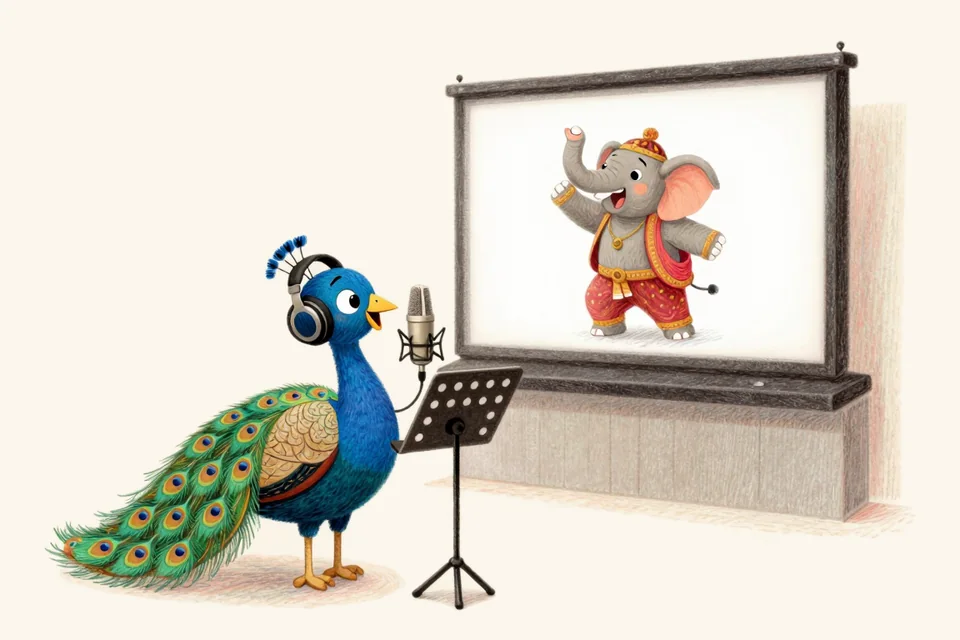
Many film songs are sung by playback singers, who record the voice while the actor on screen moves their lips. Film music mixes classical ideas, folk tunes and pop, and in recent times also electronic sounds.
Listen: why it sounds different
A lot of Indian classical music has no chord changes at all. Instead, the tanpura keeps sounding the home note Sa, usually together with Pa (a fifth away; some ragas use Ma instead), the whole time, so every note of the melody is heard against one steady hum. That is why the music can feel as if it stays in one place while the tune wanders and explores.
Each raga also picks its notes carefully. Raga Yaman, often performed in the early evening, uses all seven notes but raises ma by a half step (the tivra ma described above). Play it right after an ordinary major scale and that one raised note is the whole difference you hear.
- Seven notes with a plain fourth note.
- The same, but listen for the raised fourth note, tivra ma.
- A short phrase written for this page, over a Pa–Sa drone.
In a real performance the tanpura hums without stopping and the singer glides smoothly between notes (meend). The piano can only repeat the drone notes and jump from note to note.
Big moments in the story of India's music
- About 1200–1000 BCE (estimated)Chants with melodies
The Samaveda gathers old verses arranged to be sung to set tunes in rituals. It was passed on by memory for a very long time, and parts are still chanted today.
- About 100 BCE–300 CE (estimates vary)A big book on the arts
The Natya Shastra, a Sanskrit book about drama, dance and music, was put together around this time.
- Late 1200s–early 1300sAmir Khusrau
A poet and musician in Delhi who many stories say changed the music of his time, though the tales about what exactly he invented are mostly legend.
- 1500sTansen at the royal court
The singer Tansen joined Emperor Akbar's court, and many tales are told about him, though most are not proven.
- Lived about 1760–1847Three Carnatic masters
Tyagaraja, Muthuswami Dikshitar and Syama Sastri, called the Trinity of Carnatic music, wrote songs still sung today.
- 1931Songs on the big screen
Alam Ara, widely seen as India's first sound film, put songs into the movies.
- 1966Sitar meets pop
George Harrison of the Beatles began learning sitar from Ravi Shankar, and Indian sounds reached rock and pop fans.
- 2009A film composer wins two Oscars
A. R. Rahman won two Academy Awards for the music of Slumdog Millionaire.
Names to look up
These are only examples, not a ranking. Search for their names to listen to their music.
- Ravi Shankar
- M. S. Subbulakshmi
- Lata Mangeshkar
- Zakir Hussain
- Hariprasad Chaurasia
- Kishori Amonkar
- Bhimsen Joshi
- Tyagaraja
- Anoushka Shankar
- A. R. Rahman
Meanwhile, around the world
Here is what was happening elsewhere around the same times.
- 1454–1455Printing with movable metal type
In Europe, the Gutenberg Bible was printed, in the century before Tansen's time at court in India.
- 1508–1512Michelangelo paints a famous ceiling
In Rome, he painted the ceiling of the Sistine Chapel, several decades before Tansen joined Akbar's court.
- 1632Work on the Taj Mahal begins
In Agra, builders began a famous white marble tomb, in the century after Tansen's time at court.
- 1876The first telephone call
Alexander Graham Bell made the first successful phone call, in the same century that the harmonium arrived in India.
- 1927The Jazz Singer
A US film with synchronized singing and some speech helped sound films take off, four years before India's Alam Ara.
- 1969The first people walk on the Moon
Apollo 11 landed in July, the same year Ravi Shankar played at the Woodstock festival.
Hear the styles on this page
- Listen for the four chords going round and a short, catchy tune you could sing back right away.
- Listen for the dholak drum pattern in eight beats and the quick little turns that decorate the tune.
- Listen for the clapping, and how the group sings the leader's line again, louder each time.
- Listen for the steady drone underneath, while the raga tune slowly wakes up and bends between notes.
How this page was checked: each fact was looked up again in the sources below — encyclopedias, museums, universities, cultural institutions and makers. Wikipedia was used only as a pointer, never as a source. It has not been reviewed by an outside music expert; if you spot a mistake, please tell us at support@sunsunlabs.com.
- Encyclopaedia Britannica: raga
- Encyclopaedia Britannica: tala
- Encyclopaedia Britannica: Carnatic music
- Encyclopaedia Britannica: alap
- The Met, Heilbrunn Timeline of Art History: Musical Instruments of the Indian Subcontinent
- Encyclopaedia Britannica: sitar
- Encyclopaedia Britannica: tabla
- Encyclopaedia Britannica: tambura
- The Met: Sarangi (46.34.43)
- The Met: Saravatī Vīnā (46.34.44)
- The Met: Mrdangam (1986.467.18)
- University of Washington: Thekas for some basic talas
- Stanford CCRMA: The 12 notes
- Encyclopaedia Britannica: Tansen
- Encyclopaedia Britannica: Amīr Khusrow
- Encyclopaedia Britannica: qawwali
- UNESCO Intangible Cultural Heritage: Baul songs
- Encyclopaedia Britannica: Bollywood
- Encyclopaedia Britannica: Samaveda
- Encyclopaedia Britannica: Ravi Shankar
Piano sound: Salamander Grand Piano by Alexander Holm (CC BY 3.0).