
Music of Spain: from castle songs to flamenco guitars
Spain is famous for guitars, but its music is much bigger than that. There are old songs from royal courts, village bagpipes, dance rhythms and pop stars loved around the world.
In this lesson
What does Spanish music sound like?
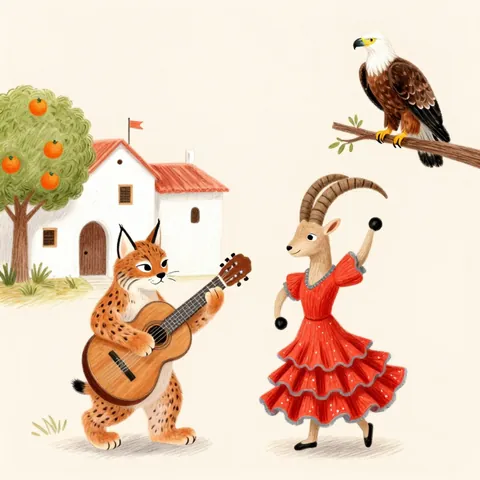
Picture someone strumming a guitar fast while another person claps a strong beat and a dancer stamps the floor. That is flamenco, a music and dance art from Andalusia in the south. It has three parts: cante (singing), toque (guitar playing) and baile (dancing). Clapping, called palmas, and castanets add more rhythm.
Spain has many local sounds. In Galicia in the northwest, the gaita (a kind of bagpipe) plays with drums. In Catalonia in the northeast, a band called a cobla plays for a circle dance named the sardana.
Long ago, King Alfonso X of Castile had a big book of more than 400 songs about the Virgin Mary written down in the 1200s, called the Cantigas de Santa María. In the 1500s, the composer Tomás Luis de Victoria wrote deeply felt church music for choirs. Later, a Spanish style of play with songs and talking, called zarzuela, became popular.
In the 1800s and 1900s, composers such as Albéniz, Granados and Falla used Spanish dance tunes in piano and orchestra pieces. Today, some Spanish pop mixes flamenco, Latin rhythms and electronic beats.
Palos and the 12-beat compás
Flamenco has many styles, called palos. Each one has its own rhythm and chord pattern, and some are named after the place they come from.
Many palos, such as soleá, use a 12-beat compás with the strong beats on 3, 6, 8, 10 and 12: one two THREE four five SIX seven EIGHT nine TEN eleven TWELVE. Other palos, like seguiriya, put the accents in other places.
Listen to those accents and you hear two groups of three, then three groups of two: 3 + 3 + 2 + 2 + 2. Mixing threes and twos like this is also heard in many Latin American styles, such as the Argentine chacarera.
Set the metronome to a slow beat and count from 1 to 12 out loud, over and over. Clap only on 3, 6, 8, 10 and 12.
The story of one song
In 1940, in Barcelona, a guitar concerto was played in public for the first time. Joaquín Rodrigo wrote it in 1939 and named it after the palace and gardens of Aranjuez. Its slow middle part is the best known: an English horn sings a quiet tune while the guitar plays softly underneath.
In 1960, the jazz trumpeter Miles Davis and the arranger Gil Evans made their own version of that slow tune for the album Sketches of Spain. It helped more people hear the tune.
Now picture Catalonia. On weekends and festivals, people join hands in a circle in a square and dance the sardana. A band of 11 players, called a cobla, plays for them. One player plays a small flute with one hand and a little drum with the other.
Instruments you may hear
Here are some instruments you can look up and listen to.
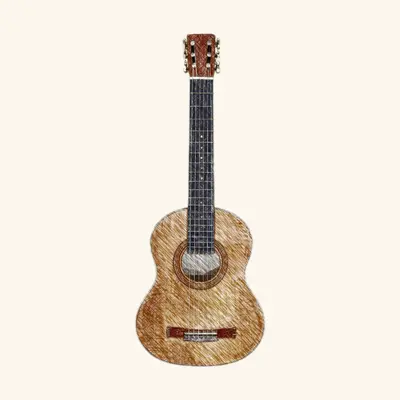 Classical guitar
A guitar with six nylon strings that is plucked with the fingers; its modern shape was shaped a lot by the guitar maker Antonio de Torres in the 1800s.
How it is built: Its body is a hollow wooden box with a very thin top, usually spruce or cedar. When a nylon string is plucked, the bridge passes the shaking to the top, which makes the air inside ring louder.
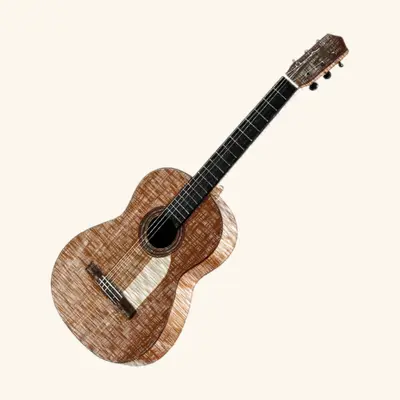 Flamenco guitar
A guitar a bit lighter and brighter than the classical one, with a plastic plate so the player can tap its wood like a drum.
How it is built: It is often built lighter than a classical guitar, with a thin top, and its back and sides are often pale cypress. A thin plastic tap plate on the top protects the wood from taps.
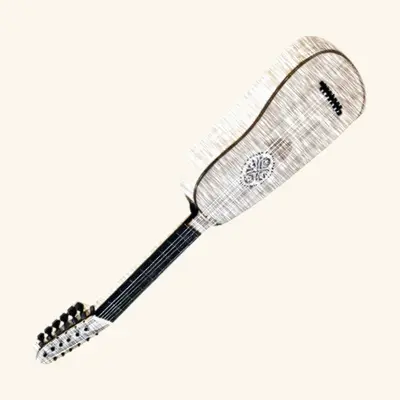 Vihuela
A plucked, guitar-shaped instrument with six pairs of strings that was popular in Spain in the 1500s.
How it is built: It has a flat, guitar-like wooden body, but its gut strings come in six pairs, and the frets are gut strings tied around the neck. Gut strings sound softer and sweeter than metal ones.
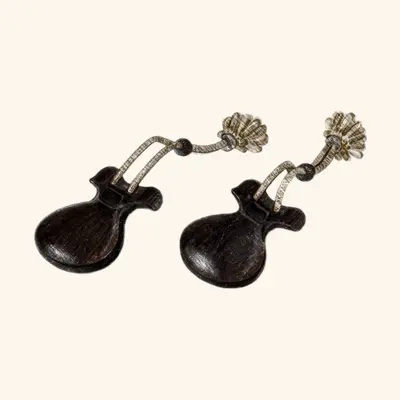 Castanets
Two small shells joined by a string, held in the hand and clicked together; the name comes from the Spanish word for chestnut.
How it is built: Each one is a pair of small, hollow, spoon-shaped shells of hardwood, tied together at one edge with a cord. The player's fingers snap them shut, and the hard wood clicks.
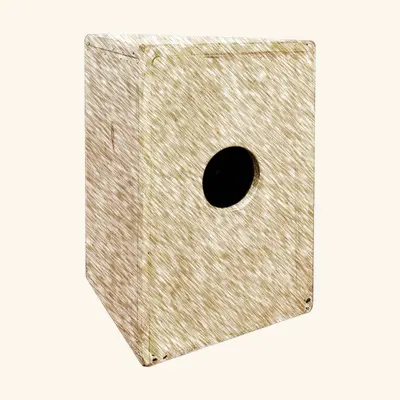 Cajón
A wooden box that the player sits on and slaps; it comes from Peru and was brought into flamenco in the late 1900s, and Paco de Lucía is often credited with this.
How it is built: It is a plain wooden box with a thin plywood front plate, called the tapa, and a round sound hole in the back. Slapping the tapa shakes the box, and the sound comes out of the hole.
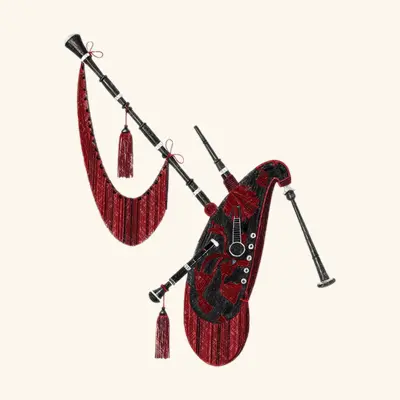 Gaita
A bagpipe from Galicia: the player fills a bag with air and presses it, so the pipes keep sounding, including a low drone.
How it is built: A leather bag is blown up through a mouth pipe. Squeezed air passes reeds in a finger-hole pipe that plays the tune and a long drone pipe that hums low.
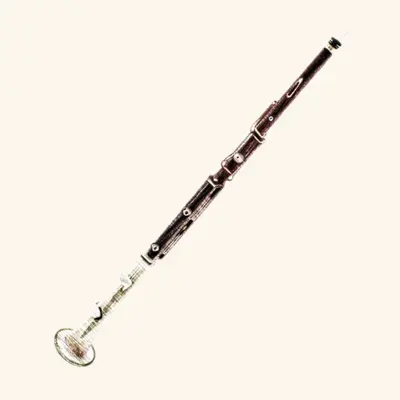 Tenora
A loud, reedy woodwind from Catalonia that often plays solo tunes in a cobla band for the sardana dance.
How it is built: It is a long wooden pipe with metal keys, played with a double reed of two thin cane pieces that buzz together. The tube widens into a flared metal bell that helps the sound carry.
Each picture is either a picture-book drawing or a simple diagram, not a photo. Small details are simplified.
The flamenco mode and the Andalusian cadence
Much flamenco uses the flamenco mode, which is close to the Phrygian mode: play the white keys from E to E, with E as home. The half step from F down to E gives it a sound many listeners call dark and dramatic.
A famous chord pattern steps down to land on that home: Am, G, F, E. It is called the Andalusian cadence, and here E, not A, feels like the end. The Scales lesson has more about modes.
On a piano or guitar, play the chords Am, G, F and E slowly, over and over. Does E sound like home?
How to listen
In Spanish music, rhythm is often easy to hear: a clap, a click, a stamp or a drum keeps everyone together. Try to find who is keeping the beat.
- Listen for a 12-beat cycle
- Many flamenco styles repeat a rhythm pattern of 12 beats called a compás, and the clapping and guitar keep it going round and round.
- Listen for the drone
- A Galician gaita plays the tune on one pipe while a low drone pipe keeps sounding underneath.
- Listen for the three-beat swing
- The jota is usually counted in three, and castanets often click along with it.
Set the Sowlea metronome to a slow tempo and count 1-2-3, 1-2-3. Clap loudly on 1 and softly on 2 and 3. Can you keep it going for one whole minute?
Listen: why it sounds different
Much of the Spanish flavor of flamenco comes from one tiny step at the end of a phrase: F moves down to E, just half a step, and E feels like home. That is the flamenco mode from above. The home chord is often a bright E major, while the tune around it uses the darker notes, so the music can sound sunny and shadowy at the same time.
The other clue is the rhythm. Instead of counting evenly in fours, many palos go round in 12 beats and lean on 3, 6, 8, 10 and 12, so the beat seems to change its stride halfway through.
- The white keys from E to E; hear how close F and E are at the bottom.
- Am, G, F, E: the chords step down and land on E.
- Two rounds of 12; the chords mark beats 3, 6, 8, 10 and 12.
Real flamenco has strummed guitar, handclaps and a singer who decorates every note; on the piano, the accents in the compás are shown with chords instead of claps.
Big moments in the story of Spanish music
- 1200sSongs for Mary
At the court of King Alfonso X, musicians made the Cantigas de Santa María, more than 400 songs written in Galician-Portuguese.
- 1536A book for the vihuela
Luis de Milán printed the first known collection of music for the vihuela, called El maestro.
- 1600sZarzuela is born
Shows with spoken scenes, songs and dances were put on for King Philip IV at his hunting lodge, La Zarzuela, and the shows took its name. El laurel de Apolo is one famous early example.
- Late 1700sFlamenco takes shape
In Andalusia, the songs that grew into flamenco took shape. Guitar and dance became bigger parts of it in the 1800s.
- 1850sA new guitar shape
Antonio de Torres began building guitars that set many features of today's classical guitar, such as fan-shaped bracing inside, which other makers soon copied.
- 1905–1909Iberia for piano
Isaac Albéniz wrote Iberia, twelve piano pieces full of Spanish rhythms.
- 1940Concierto de Aranjuez
Joaquín Rodrigo's guitar concerto was first played in Barcelona on 9 November.
- 2018Flamenco meets pop
Rosalía released El mal querer, which mixes flamenco with pop and electronic sounds.
Names to look up
These are only examples, not a ranking. Search for their names to listen to their music.
- Tomás Luis de Victoria
- Isaac Albéniz
- Manuel de Falla
- Andrés Segovia
- Paco de Lucía
- Camarón de la Isla
- Carmen Linares
- Montserrat Caballé
- Alejandro Sanz
- Rosalía
Meanwhile, around the world
While Spanish music grew, here is what was happening in other places.
- 1271Marco Polo sets out
The young Venetian began his long trip to Asia, around the time the Cantigas were being collected.
- 1564Shakespeare is born
The English writer was born in Stratford-upon-Avon, while the composer Tomás Luis de Victoria was still alive.
- 1756Mozart is born
The composer was born in Salzburg on 27 January, some years before flamenco took shape in Andalusia.
- 1851The Great Exhibition
A huge fair of inventions opened in London in the Crystal Palace, in the decade of Torres's new guitars.
- 1905Einstein's big year
Albert Einstein published four famous science papers, the same year Albéniz began Iberia.
- 1969First Moon landing
Apollo 11 landed on the Moon on July 20.
Hear the styles on this page
- Listen for the four chords going round and a short, catchy tune you could sing back right away.
How this page was checked: each fact was looked up again in the sources below — encyclopedias, museums, universities, cultural institutions and makers. Wikipedia was used only as a pointer, never as a source. It has not been reviewed by an outside music expert; if you spot a mistake, please tell us at support@sunsunlabs.com.
- UNESCO Intangible Cultural Heritage – Flamenco
- Encyclopaedia Britannica – Flamenco
- The Metropolitan Museum of Art – The Spanish Guitar (Timeline of Art History)
- Encyclopaedia Britannica – Cantigas de Santa María
- Encyclopaedia Britannica – Zarzuela
- Encyclopaedia Britannica – Vihuela
- Encyclopaedia Britannica – Castanets
- Real Academia Española, Diccionario de la lengua española – castañuela
- Encyclopaedia Britannica – Tomás Luis de Victoria
- Encyclopaedia Britannica – Isaac Albéniz
- Fundación Victoria y Joaquín Rodrigo – The world premiere (Concierto de Aranjuez)
- Hollywood Bowl / LA Phil – Concierto de Aranjuez program note
- Miles Davis official site – Sketches of Spain
- Ajuntament de Barcelona, Cultura Popular – Cobla
- Ajuntament de Barcelona, Cultura Popular – Tenora
- Encyclopaedia Britannica – Jota
- El Comercio (Perú) – Paco de Lucía: la historia de cómo llevó el cajón a España
- NPR – Flamenco Fusion: Rosalía Offers A Modern Take On Spanish Traditions
- Universidad de Córdoba, Musicalia – Cera Vera, Relaciones… entre la soleá, la seguirilla y la bulería
- Neuma (Universidad de Talca) – Blasco, Acerca de la cadencia frigia, la cadencia andaluza y la tonalidad menor
Piano sound: Salamander Grand Piano by Alexander Holm (CC BY 3.0).