
Music of South Korea: from silk-string zithers to K-pop
Korean music has quiet palace songs, loud village drums and stage shows that people watch all over the world. Many of the oldest tunes belong to the shared tradition of the Korean Peninsula, and this page follows the sounds from long ago to today.
In this lesson
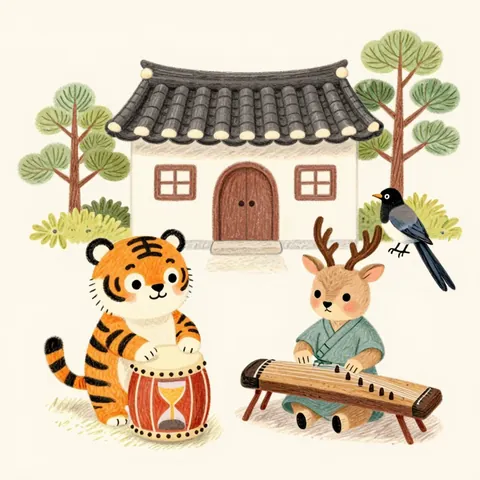
What does Korean music sound like?
Imagine a long wooden zither lying across a player's lap. Silk strings are plucked and bent, so each note can slide and wobble like a voice. That is the gayageum, and its gentle, singing sound is a good first taste of Korean tradition.
Old Korean music had many homes. At the royal court, slow and calm pieces were played at big ceremonies. One famous example is the music for the Jongmyo ritual, held once a year to honour the ancestors of the Joseon kings. Out in the villages, farmers marched with gongs and drums in a lively band music called nongak.
There are also stories told with songs. In pansori, one singer tells a long tale with singing, speaking and acting, while one drummer keeps the beat and shouts cheers. A folk song called Arirang is loved so much that people sing it in many versions, and UNESCO lists it as living heritage.
In the 1900s, new sounds arrived. Church hymns and Western songs came in, and Koreans wrote their own songs in that style. Later, a pop style called trot became popular, with singers such as Lee Mi-ja. After 1992 a new wave began, with rap and dance beats, which grew into K-pop. By the 2010s and 2020s, K-pop groups and songs were known around the world.
Jangdan: rhythm cycles with names
A jangdan is a rhythm cycle played on the janggu drum. Each one has its own length, speed and mood.
Semachi has three beats at a medium, lively speed. Jungmori has 12 beats at a medium speed, and gutgeori also has 12 beats. Jinyangjo, one of the slowest, has 24 beats: four groups of six.
In semachi, each beat is split into three small parts, so it is often written as 9/8. Some other jangdan, like the fast jajinmori, are often written with beats split in three (12/8), which gives a swaying feel.
Set the metronome to 3 beats per bar at a medium speed. On every click, say “one-two-three” quickly, so each beat splits into three. That is the feel of semachi.
The story of one song: Arirang
Many Koreans know a refrain that goes "Arirang, arirang, arariyo." It is the heart of a folk song that people have sung for a very long time.
After the refrain come two short lines, and each region sings its own. Experts count about 3,600 versions, grouped into around 60 main ones. Songs of longing, parting and hope are common.
Because the tune is simple, anyone can join in and make up new words. UNESCO added Arirang to its heritage list in 2012.
Traditional instruments
Here are some instruments you can look up and listen to.
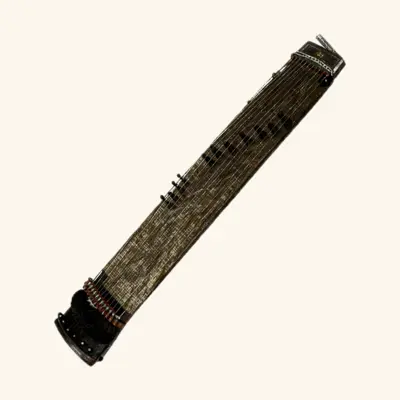 Gayageum
A zither with 12 silk strings; the player sits on the floor, plucks with the right hand and presses and bends the strings with the left.
How it is built: The long body has a top of light paulownia wood. Each silk string rests on its own movable bridge, and sliding a bridge changes the note.
- Geomungo
A six-string zither with raised frets, played with a short stick; old records credit a minister of the Goguryeo kingdom with making it.
How it is built: The long hollow body has a paulownia wood top, a chestnut wood back and 16 raised frets. Of its six strings, some are pressed on the frets and some are played open, plucked with a stiff bamboo stick.
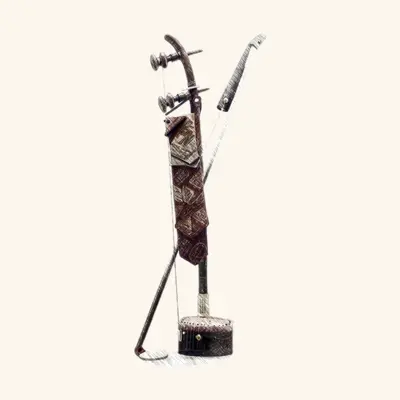 Haegeum
A fiddle with two strings held upright on the knee; the bow slides between the strings, and the player has no fingerboard to press on.
How it is built: A thin rod, often of bamboo, holds a small hollow sound box at the bottom, often a bamboo tube with a thin wooden top. Two silk strings run up the rod, and the bow hair is threaded between them.
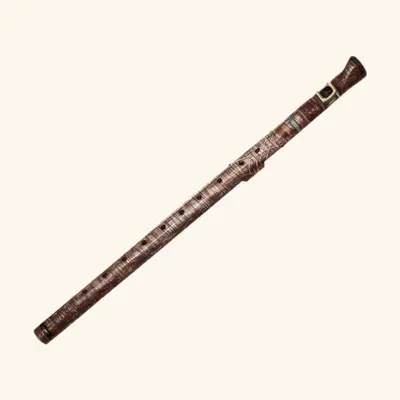 Daegeum
A big bamboo flute played sideways, with a special hole covered by a thin reed membrane that adds a soft buzzing sound.
How it is built: It is a long bamboo tube with a blow hole, six finger holes and one extra hole covered with a thin membrane. The membrane buzzes when air passes over it.
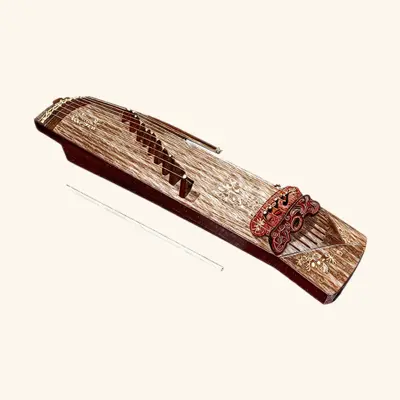 Ajaeng
A wide zither with silk strings that is played by rubbing a stick of forsythia wood across them like a bow; it has a deep, low sound.
How it is built: A wide, long wooden box holds usually seven or eight twisted silk strings, each held up by a movable bridge. A stick is rubbed on them like a bow, so the strings sing instead of being plucked.
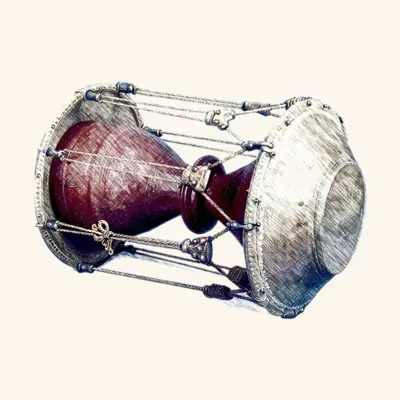 Janggu
An hourglass-shaped drum with two heads: often one is struck with a thin stick and the other with the bare hand (some folk styles use two sticks), and the two sides sound different.
How it is built: The hourglass-shaped body has a narrow middle waist, and both ends are covered with animal skin. One head sounds low and the other sounds higher; they are hit with a thin stick and the bare hand, or with two different sticks.
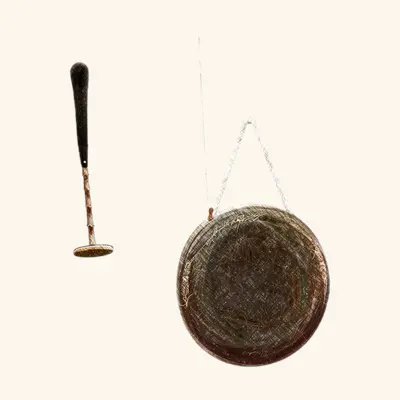 Kkwaenggwari
A small gong held in the hand; its player leads a nongak band.
How it is built: It is a small flat gong made of brass with an open back. Players hit the front with a hard wooden mallet and use a hand behind it to soften the sound.
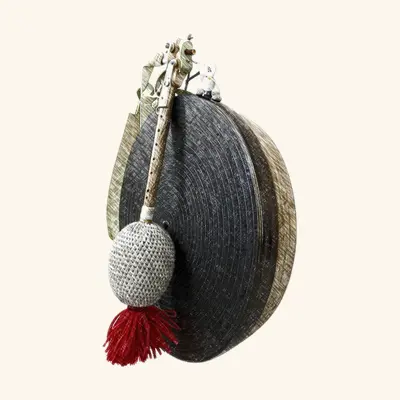 Jing
A large gong that gives a deep, long ring, played in nongak and samulnori.
How it is built: It is a large round gong made of brass. A stick wrapped in cloth at one end strikes it, so the sound is soft and long; hit harder, it roars.
Each picture is either a picture-book drawing or a simple diagram, not a photo. Small details are simplified.
Two big families: jeongak and minsogak
Koreans often sort traditional music into two big families. Jeongak is the music of the court and of educated people, like the ritual music for Jongmyo described above.
Minsogak is folk music, the other half of the pair. It includes folk songs (minyo), pansori, sanjo and sinawi, a group music that is made up on the spot. Farmers' band music such as nongak is also counted as folk music.
How to listen
Close your eyes and follow one sound at a time. Ask yourself: is it getting faster? Is the note sliding? Is the drum repeating a pattern?
- Listen for bending notes
- On the gayageum, the left hand pushes a string to raise the note and add a wobble, so a note can sing like a voice.
- Listen for a slow start and a fast finish
- A sanjo solo begins with a very slow rhythm and speeds up to a fast one, and the janggu drummer shouts cheers along the way.
- Listen for repeating drum patterns
- Korean music uses rhythm patterns called jangdan, repeated on the janggu, whose two heads give a low sound and a higher sound.
Set a metronome to a slow 50 BPM and clap along. After every 8 claps, raise the speed a little, like a sanjo growing faster. How fast can you stay in time?
Listen: why it sounds different
A lot of Korean folk music sways in threes. Where many tunes march left–right, a jangdan like semachi, described above, feels like long–short, long–short, because each beat is split into three. Arirang is often written this way, in 9/8, which is why it rocks gently instead of marching.
Many tunes use five notes, and some regional styles lean on just three main ones, but Korean singers and players spend a lot of time on single notes: shaking them with a deep vibrato, pushing them up, or letting them fall. That decoration, more than the scale, gives many Korean tunes their color, and it is the part a piano cannot copy.
- The five notes the song uses, with F as home.
- The first line, over a long–short beat in threes.
- A short tune written for this page in the semachi feel.
Semachi is really played on the janggu drum, and the singer's notes would wobble and slide. Here low piano notes stand in for the drum, and the long–short pattern is a simple approximation, not an exact janggu part.
Big moments in the story of Korean music
- About 500sZithers of the old kingdoms
Old records say the gayageum was made in the Gaya kingdom in the 500s, and the geomungo in the Goguryeo kingdom, though its exact date is not certain.
- 1400sA way to write music down
In King Sejong's time, a notation called jeongganbo was made, which used a grid to show both pitch and length of notes.
- 1600sPansori appears
Singers began telling long stories with voice and drum; the form later became famous across the peninsula.
- About 1890Sanjo is born
Kim Chang-jo is said to have shaped sanjo around 1890: a long solo piece for the gayageum that starts slow and speeds up.
- About 1920A song in Western style
The composer Hong Nan-pa wrote the tune of Bongseonhwa in 1920; it is often named as one of the first Korean art songs in Western style.
- 1992Rap and dance arrive
Seo Taiji and Boys sang Nan Arayo, mixing rap and dance beats, and it became a huge hit.
- 1996–2012K-pop goes wide
H.O.T. debuted in 1996 and helped set the pattern for later K-pop idol groups; in 2012 Psy's Gangnam Style became the first YouTube video to reach a billion views.
- 2020Dynamite tops the US chart
BTS sang Dynamite fully in English, and it debuted at number one on the US Billboard Hot 100 in August.
Names to look up
These are only examples, not a ranking. Search for their names to listen to their music.
- Hwang Byungki
- Ahn Sook-sun
- Kim Duk-soo
- Lee Mi-ja
- Cho Yong-pil
- Unsuk Chin
- Seo Taiji and Boys
- IU
- BTS
- BLACKPINK
Meanwhile, around the world
While Korean music grew, here is what was happening in other places.
- 537Hagia Sophia is finished
In what is now Istanbul, a giant domed church was completed, around the time the gayageum was being made in the Gaya kingdom.
- About 1455The Gutenberg Bible
In Germany, books printed with movable type began to appear, in the same century as Korea's music notation.
- 1685Bach is born
The German composer Johann Sebastian Bach was born, around the time pansori storytelling was taking shape.
- 1964The Beatles on American TV
The band played on The Ed Sullivan Show in February 1964, and tens of millions watched.
- 1969First Moon landing
Apollo 11 landed on the Moon on July 20.
- 2005YouTube begins
The first video was uploaded in April, and the site later helped songs like Gangnam Style travel the world.
Hear the styles on this page
- Listen for the "boom" of the kick and the "bap" of the snare under a short piano loop that repeats.
- Listen for the change in the middle: a hip-hop beat first, then a dance beat with a kick on every beat.
How this page was checked: each fact was looked up again in the sources below — encyclopedias, museums, universities, cultural institutions and makers. Wikipedia was used only as a pointer, never as a source. It has not been reviewed by an outside music expert; if you spot a mistake, please tell us at support@sunsunlabs.com.
- UNESCO ICH – Arirang, lyrical folk song in the Republic of Korea
- UNESCO ICH – Pansori epic chant
- UNESCO ICH – Jongmyo Jerye and Jongmyo Jeryeak
- UNESCO ICH – Nongak, community band music, dance and rituals
- National Gugak Center (Google Arts & Culture) – Korean traditional instruments
- National Gugak Center (Google Arts & Culture) – Geomungo
- National Gugak Center (Google Arts & Culture) – Gayageum
- Ohio State University, Korean Performing Arts – P'ansori
- Ohio State University, Korean Performing Arts – Sanjo
- Smithsonian National Museum of Asian Art – Korean music program notes
- Smithsonian National Museum of Asian Art – Five Directions program notes (sinawi)
- Museu de la Música de Barcelona (Google Arts & Culture) – Sanjo
- Transactions of the International Society for Music Information Retrieval – Jeongganbo article
- The Review of Korean Studies – Court music, private music and notation of the Joseon dynasty
- Journal of Korean and Asian Arts – Chun In-Pyong, comparative study of rhythm
- Journal of Korean and Asian Arts – Park Sa Ra, performance analysis of Bonjo Arirang
- Sejong Cultural Society – Arirang
- Yale MacMillan Center – Sounds of Korea: gayageum workshop
- Wesleyan University Virtual Instrument Museum – Kkwaenggwari
- The Korea Times – 100 years of Korean gagok
Piano sound: Salamander Grand Piano by Alexander Holm (CC BY 3.0).