
The staff: how music is written
Music can be written down, so a person far away, or many years later, can play it exactly as it was meant to be played. The writing uses five lines, a few signs and notes placed high or low. It looks like a secret code, but it is really a picture of how high each note sounds.
In this lesson
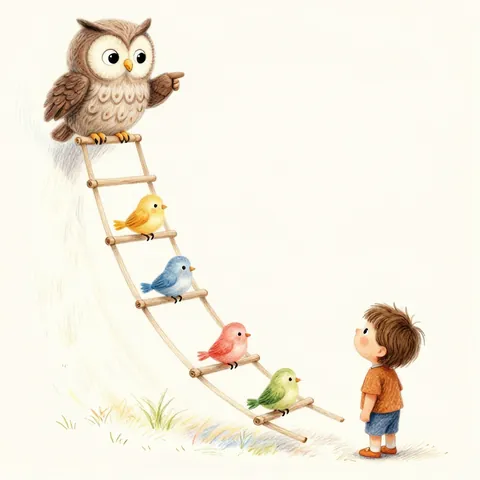
The staff: a ladder for notes
Music is written on a staff: five lines with four spaces between them. Think of a ladder lying on its side. Each line and each space is one step of the ladder. We count the lines from the bottom: the lowest line is line 1.
A note sits either on a line or in a space. The higher the note sits, the higher it sounds. Press the button to hear nine notes climb the ladder one step at a time.
Try it: tap any note to hear it. Is a note that sits higher also higher in sound?
The clef: which notes live where
The curly sign at the start of the staff is called a clef. It tells you which note each line stands for. Without a clef, the lines could mean any notes.
There are two clefs you will meet most. The treble clef is for higher notes. The bass clef is for lower notes. Piano music uses both: the right hand usually reads the treble clef and the left hand reads the bass clef.
Tap a note to hear it.
The grand staff: two staves for the piano
Piano music needs both high and low notes, so it uses two staves joined on the left by a brace: a treble staff on top and a bass staff below. Together they are called the grand staff. The right hand usually reads the top staff and the left hand the bottom one, but either hand can play notes from either staff.
Middle C sits between the two staves. It can be written on a short ledger line just below the treble staff, or just above the bass staff: the same key, written in two places. So the two staves work like one long ladder, with middle C in the gap.
C clefs: alto and tenor
There is a third kind of clef, the C clef. The line that runs through its centre is middle C. When it sits on the middle line, it is called the alto clef, and the viola reads it most of the time. When it sits on the fourth line, it is called the tenor clef; cellos, bassoons and trombones use it for their higher notes.
Why not just use the treble or bass clef? A C clef keeps the instrument's usual notes on the staff with fewer ledger lines. Below, the same note, middle C, is written in four clefs.
- Treble clef
- Alto clef
- Tenor clef
- Bass clef
Reading note names on the staff
Each line and each space has a note name, and the names climb through the alphabet: A B C D E F G, then A again. Move up from a line to the next space, and you move to the next letter.
In the treble clef the lines, from the bottom to the top, are E G B D F. The spaces are F A C E. In the bass clef the lines are G B D F A and the spaces are A C E G.
You do not have to learn them all at once. Learn the line where your clef starts (G in the treble clef, F in the bass clef) and count up or down from there.
Tap a note to hear it.
Middle C and ledger lines
What if a note is higher or lower than the five lines? Then we add a short extra line just for that note. It is called a ledger line.
The most important ledger-line note is middle C, the C near the middle of the piano. It sits on one ledger line below the treble staff, and on one ledger line above the bass staff. It is the same key on the piano. It is the meeting point of the two clefs.
8va: play it an octave higher
Very high or very low notes would need many ledger lines, which are hard to read. Instead, they can be written an octave closer to the staff with a sign. 8va (from the Italian ottava, "octave") with a dashed line above the notes means: play everything under the line one octave higher than written.
Under the notes, 8vb (or 8va bassa) means one octave lower, and 15ma means two octaves higher. Where the dashed line ends, or where the word loco appears, you play the notes as written again.
- With ledger lines
- The same notes with 8va
Sharps, flats and naturals
A sign in front of a note can change it by a half step. A sharp (♯) makes the note one half step higher. A flat (♭) makes it one half step lower. A natural (♮) cancels a sharp or a flat and takes the note back to its plain name.
On the piano, sharps and flats are mostly the black keys. They are written before the note they change.
How long a sharp lasts, double sharps, and two names for one key
A sharp, flat or natural written in front of a note lasts until the end of that bar: later notes on the same line or space in that bar are changed too. At the bar line it stops, and in the next bar the note goes back to normal, unless the key signature says otherwise. Music sometimes adds a reminder in the next bar, called a courtesy accidental.
There are also double signs. A double sharp (𝄪) raises a note by two half steps, and a double flat (𝄫) lowers it by two. F𝄪 is played on the same key as G.
That is why one key can have two names. C♯ and D♭ are the same black key, and E♯ is the same key as F. Notes like these are called enharmonic. Which name is written depends on the key and the chord the note belongs to.
- F♯ twice in the first bar; in the second bar it is F again.
Little quiz: name the note
Look at the note on the treble staff and pick its name. Use the lines (E G B D F) and the spaces (F A C E) to find it.
Piano sound: Salamander Grand Piano by Alexander Holm (CC BY 3.0).