
The voice: the instrument you carry with you
Probably the oldest instrument is the one you were born with. Your voice has a power source, a vibrator and a loudspeaker, just like a guitar or a trumpet, and you carry it everywhere.
In this lesson

How the voice works
A voice has three parts. The lungs push air upward like bellows. The vocal folds, two small folds of soft tissue in the throat, close a little and vibrate as the air passes. Then the throat, mouth and nose shape the sound into vowels and words.
To sing a higher note, the folds stretch thinner and shake faster. For a lower note, they relax and shake more slowly. That is the same idea as a tight and a loose string.
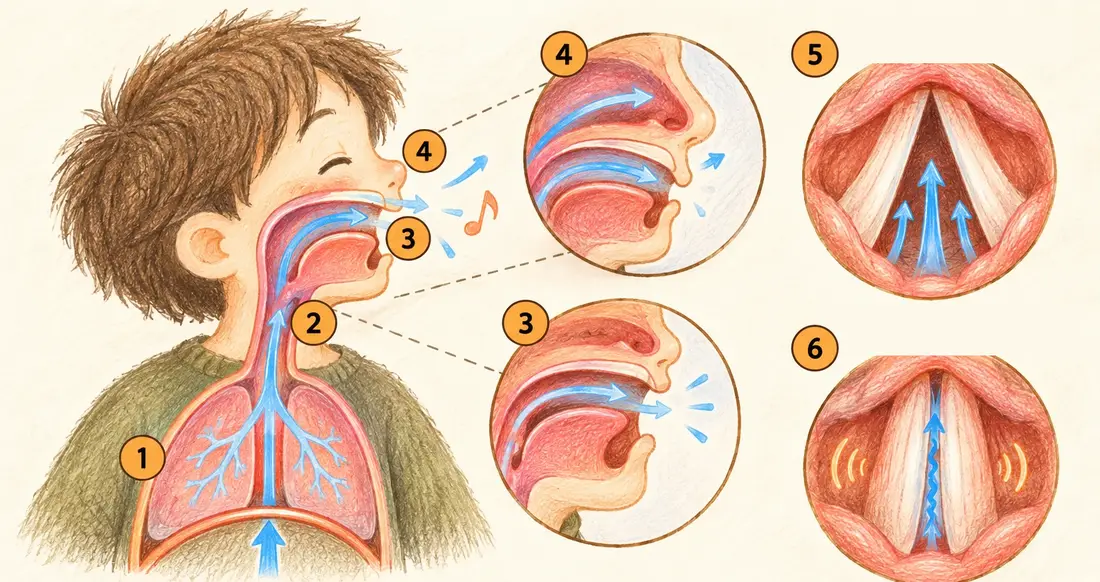
- The lungs work like bellows, pushing air upward
- The vocal folds sit in the throat, behind the Adam’s apple
- The mouth: the tongue and lips change shape to make different sounds
- The nose: some of the sound resonates here
- When you breathe, the two folds open into a V and air passes quietly
- When you speak or sing, the folds close and the air makes them vibrate very fast
Four main voice types
Singers are grouped by the range of notes they sing most comfortably. Everyone's voice is a little different.
- Soprano
- The highest voice. Often sings the main tune in a choir.
- Alto
- A lower, warm voice that sings the notes below the soprano.
- Tenor
- The highest of the usual men's voices.
- Bass
- The lowest voice, deep and rich.
Singing together: the choir
A choir often has the four voice types singing together, each on its own line. The result sounds like a chord: four different notes that fit together. Choirs sing in schools, churches, theatres and concert halls all over the world.
Looking after your voice
A voice is part of your body, so treat it kindly. Drink water, do not shout for a long time, and rest your voice when it feels tired. If singing hurts, stop and rest; if it keeps hurting, ask a singing teacher or a doctor.
Piano sound: Salamander Grand Piano by Alexander Holm (CC BY 3.0).