
Johann Sebastian Bach: the master of woven melodies
Johann Sebastian Bach lived in Germany about 300 years ago. He played the organ, wrote music for churches, for royal courts and for his students, and his pieces are still played in concert halls and music lessons today.
In this lesson
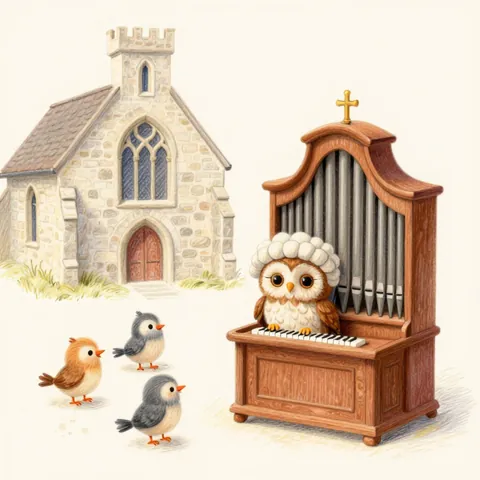
A family of musicians
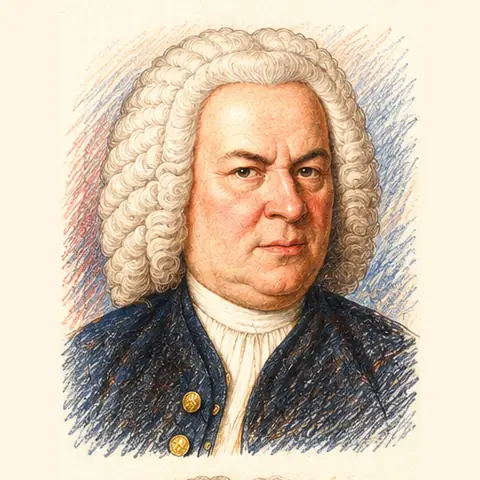
Bach was born in 1685 in the town of Eisenach, in Germany. Many people in his family were musicians, so music was part of everyday life. He lost his mother when he was nine, and his father less than a year later, just before he turned ten. He then went to live in the town of Ohrdruf with his older brother Johann Christoph, who was an organist and taught him more music.
When he grew up, he worked as an organist and as a musician for churches and for noble families in several German towns, including Weimar, Köthen and Leipzig. In Leipzig, he trained choirs and wrote music for the church services for about 27 years. He died in 1750.
A turning point
When Bach was ten, he moved in with his older brother, who taught him more music. A few years later, at about fifteen, he went to a school in Lüneburg. There he sang in the choir and could use the school's big music library.
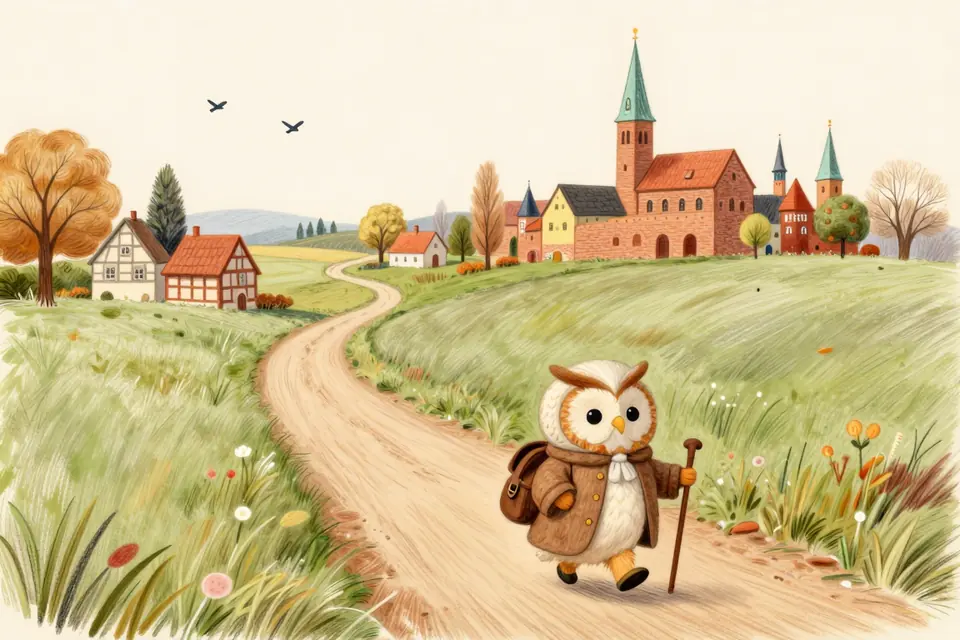
Years later, as a young organist in Arnstadt, he wanted to hear a famous organist named Buxtehude. Buxtehude worked in Lübeck, more than 300 kilometres away. Bach reportedly went on foot.
He asked for four weeks off, but stayed away much longer, about three or four months by different accounts. His bosses were not happy, but he came home with many new ideas for his organ music.
The art of weaving melodies
Bach was famous for counterpoint, which means playing several melodies at the same time so that they fit together, like threads in a cloth. One simple way to do it is a round, where the same tune starts again and again, one voice after the other. Bach used this idea in a much more clever way, in pieces called fugues.
Try it: sing a song you know in a round with a friend, with the second voice starting one line later.
Some famous pieces
Bach wrote a huge number of pieces. Here are a few that people love.
- The Brandenburg Concertos
- Six lively pieces for different groups of instruments, which he sent in 1721 to a nobleman, the Margrave of Brandenburg.
- The Well-Tempered Clavier
- Two books of preludes and fugues in all 24 major and minor keys, great for studying music.
- The Cello Suites
- Six pieces for a cello playing alone.
- Toccata and Fugue in D minor
- A dramatic piece for organ, very famous for its first notes. It is traditionally credited to Bach, though experts still discuss how and when it was written.
Try listening for
- Air from Orchestral Suite No. 3
- Listen for the slow, steady bass notes walking underneath while the violins sing one long, calm tune above.
- Air from Orchestral Suite No. 3 · The main tune, a short excerpt played on our piano from a public-domain score.
- Jesu, Joy of Man's Desiring
- Listen for the busy, flowing notes that keep rolling along while the choir sings a simple hymn tune on top.
- Invention No. 1 in C major
- Listen for a short tune in one hand that the other hand soon copies, so the two hands chase each other.
- Invention No. 1 in C major · The main tune, a short excerpt played on our piano from a public-domain score.
- Goldberg Variations
- Listen for the calm opening tune, which comes back at the very end, like arriving home after a long trip.
- Goldberg Variations: Aria · The main tune, a short excerpt played on our piano from a public-domain score.
Play the Air and tap the slow, steady beat with your finger. Then play Invention No. 1 and hum its first short tune. Can you hear when it starts again in the other hand?
Forgotten, then loved
During his life, Bach was known mostly as a great organist and keyboard player. After he died, many of his pieces were played much less often. In 1829, the young composer Felix Mendelssohn conducted Bach's St Matthew Passion in Berlin, and many more people began to love Bach's music again. Today he is thought of as one of the greatest composers in history.
Meanwhile, around the world
- 1685Handel is born
The composer George Frideric Handel was born in Halle, Germany, in the same year as Bach.
- 1700–1710A new keyboard
In Florence, Italy, Bartolomeo Cristofori built an early piano, a keyboard that could play soft and loud.
- 1703A new city
Tsar Peter the Great founded Saint Petersburg in Russia, which later became a famous city for music.
- 1703A puppet play
In Osaka, Japan, the writer Chikamatsu Monzaemon's puppet play The Love Suicides at Sonezaki was a big hit.
- 1725Four Seasons printed
Vivaldi's violin concertos The Four Seasons were published in Amsterdam, in the Dutch Republic.
How this page was checked: each fact was looked up again in the sources below — encyclopedias, museums, universities, cultural institutions and makers. Wikipedia was used only as a pointer, never as a source. It has not been reviewed by an outside music expert; if you spot a mistake, please tell us at support@sunsunlabs.com.
- Encyclopaedia Britannica: Johann Sebastian Bach
- Bachfest Leipzig / Bach-Archiv: Johann Sebastian Bach – chronology
- Thüringen Tourismus (Bach in Thüringen): Bach in Ohrdruf
- Thüringen Tourismus (Bach in Thüringen): Biographische Stationen
- Classic FM: Bach's biography, part 2
- Classic FM: Bach's biography, part 3 – professional organist (1703–1708)
- Classic FM: Johann Sebastian Bach (composer page)
- WPR (Wisconsin Public Radio): Bach takes his leave
- Encyclopaedia Britannica: Brandenburg Concertos
- Orchestra of the Age of Enlightenment: Bach's Brandenburg Concertos
- Netherlands Bach Society: The Well-Tempered Clavier I, BWV 846
- Netherlands Bach Society: Cello Suite No. 1, BWV 1007
- Netherlands Bach Society: Toccata and Fugue in D minor, BWV 565
- Netherlands Bach Society: Goldberg Variations, BWV 988
- BBC Music Magazine (classical-music.com): The fugue
- BBC Music Magazine (classical-music.com): Why Bach was the composer who changed music forever
- University of Minnesota (Experts@Minnesota): Mendelssohn and the institution(s) of German art music
- All Classical Portland: Jesu, Joy of Man's Desiring (Cantata BWV 147)
- PTNA Piano Music Encyclopedia: Bach, Invention No. 1 in C major, BWV 772
- Japan Foundation: Sonezaki Shinju – The Love Suicides at Sonezaki
- Score for the piano excerpt — Air from Orchestral Suite No. 3: Mutopia Project, Air (BWV 1068, Mvmt. 2) — typeset by Jeff Covey (CC BY-SA 3.0)
- Score for the piano excerpt — Invention No. 1 in C major: Mutopia Project, Invention 1 (BWV 772) — typeset by Jeff Covey (CC BY-SA 3.0)
- Score for the piano excerpt — Goldberg Variations: Aria: Mutopia Project, Goldberg Variations - Aria (BWV 988) — typeset by JD Erickson (CC BY-SA 3.0)
Piano sound: Salamander Grand Piano by Alexander Holm (CC BY 3.0).