
Scott Joplin: the King of Ragtime
Scott Joplin was an American pianist and composer. He wrote ragtime, piano music with a bouncy, skipping rhythm that makes you want to tap your feet. People called him the "King of Ragtime".
In this lesson

A boy from Texas who loved the piano
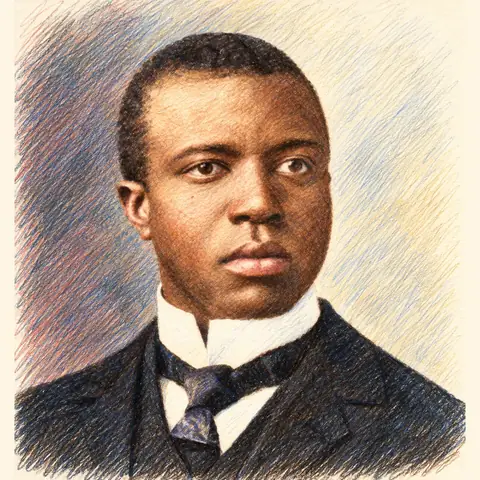
Scott Joplin came into the world in Texas, in the United States, around 1868; nobody is sure of the exact date. He grew up in the town of Texarkana. His family was musical: there was singing and banjo from his mother, and violin from his father.
As a young man he played the piano in clubs in Sedalia, a town in Missouri. Later he lived in St. Louis and then in New York. He died in New York in 1917.
A rag goes to print
In Sedalia, Joplin played in clubs and studied music at a college. In 1899, a publisher, John Stark, printed his Maple Leaf Rag as sheet music, so pianists everywhere could learn it.
Joplin kept on writing music until he became very ill near the end of his life. After he died, fewer people played his rags. Then in 1973 the movie The Sting used his music, and The Entertainer became popular again.
In 1976, he was given a special Pulitzer Prize citation, an honour for his music.
Music that skips and bounces
Ragtime is mostly written for the piano. The word "rag" probably comes from "ragged", because the rhythm sounds a little bumpy, like a skip.
Here is the secret. The left hand walks along steadily, one step on every beat, just like your foot tapping to a song. The right hand plays the tune, but it likes to jump in between the beats instead of landing right on them. Think of the "and" when you count "1 and 2 and 3 and 4 and". That jumping-in-between is called syncopation.
Because the left hand never stops, the music keeps its steady beat, and the right hand can play around on top.
Try listening for
These four pieces show how ragtime sounds.
- Maple Leaf Rag
- Listen for the left hand striding along while the right hand skips in between the beats.
- The Entertainer
- Listen for the bright, happy tune that bounces up and down like a ball.
- Elite Syncopations
- Listen for the tune that keeps jumping just ahead of the beat.
- Treemonisha
- Listen for the singers answering each other, and for the dance music.
Listen to Maple Leaf Rag and tap your foot on every beat. Can you hear the right hand jumping in between your taps?
Some pieces to know
Joplin wrote many piano rags, plus a few songs and two operas. The first opera is now lost.
- Maple Leaf Rag
- His most famous rag, published in 1899 in the United States. It may be named after a place in Sedalia, Missouri, but that link is not proven.
- Maple Leaf Rag · The main tune, a short excerpt played on our piano from a public-domain score.
- The Entertainer
- A cheerful rag from 1902 that is still known all over the world.
- The Entertainer · The main tune, a short excerpt played on our piano from a public-domain score.
- Elite Syncopations
- A rag published in 1902, with plenty of offbeat jumps in the tune.
- Elite Syncopations · The main tune, a short excerpt played on our piano from a public-domain score.
- Treemonisha
- An opera in three acts, with its piano-and-voice music published in 1911. It was first fully staged in 1972.
Meanwhile, around the world
- 1889The Eiffel Tower opens
In Paris, the Eiffel Tower was built for the world fair.
- 1893A symphony from the New World
In New York, Dvořák's Symphony No. 9, "From the New World", was first played.
- 1899A rag on paper
In Missouri, in the United States, Joplin's "Maple Leaf Rag" was published.
- 1903The first airplane flights
In North Carolina, in the United States, the Wright brothers made the first flights in a powered airplane.
- 1913A ballet that caused a stir
In Paris, Stravinsky's The Rite of Spring was first danced, with music so new that the audience made a lot of noise.
Hear the styles on this page
- Listen to the left hand: a low note, then a chord, like a march, while the right-hand tune lands between the beats.
How this page was checked: each fact was looked up again in the sources below — encyclopedias, museums, universities, cultural institutions and makers. Wikipedia was used only as a pointer, never as a source. It has not been reviewed by an outside music expert; if you spot a mistake, please tell us at support@sunsunlabs.com.
- Britannica: Scott Joplin
- State Historical Society of Missouri, Historic Missourians: Scott Joplin
- State Historical Society of Missouri, Missouri Encyclopedia: Joplin, Scott
- Texas State Historical Association, Handbook of Texas: Joplin, Scott
- CALS Encyclopedia of Arkansas: Scott Joplin
- The Pulitzer Prizes: Scott Joplin, Special Citation 1976
- Britannica: Ragtime
- Carnegie Hall, Timeline of African American Music: Ragtime
- Britannica: Eiffel Tower
- Dvořák American Heritage Association: Celebrating the New World Symphony
- Smithsonian National Air and Space Museum: 1903 Wright Flyer
- Britannica: The Rite of Spring
- Score for the piano excerpt — Maple Leaf Rag: Mutopia Project, Maple Leaf Rag (S. Joplin) — maintainer Chris Sawer, from the original 1899 edition (public domain)
- Score for the piano excerpt — The Entertainer: Mutopia Project, The Entertainer (S. Joplin) — maintainer Chris Sawer, from the original 1902 edition (public domain)
- Score for the piano excerpt — Elite Syncopations: Mutopia Project, Elite Syncopations (S. Joplin) — maintainer Benjamin Bloomfield, from John Stark & Son (public domain)
Piano sound: Salamander Grand Piano by Alexander Holm (CC BY 3.0).