
Louis Armstrong: the Trumpet Player Who Sang
Louis Armstrong was a trumpet player and singer from New Orleans, in the United States. He became one of the most famous jazz musicians ever, and people called him "Satchmo".
In this lesson
A boy from New Orleans
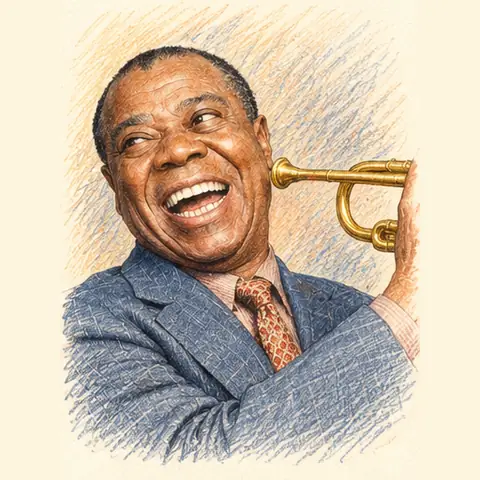
Louis Armstrong was born in New Orleans on 4 August 1901. For most of his life he said his birthday was 4 July 1900, but a church baptism record found after he died shows 1901. As a boy he learned to play the cornet, a close cousin of the trumpet.
Friends and fans called him "Satchmo" and "Pops". He played and sang for many years, and he died in New York City in 1971.
From New Orleans to Chicago
Jazz grew up mostly in New Orleans in the late 1800s and early 1900s, the same city where Armstrong was born. It mixes blues, ragtime, marches and many rhythms.
In 1922, he moved to Chicago to play in King Oliver's band. A few years later he made records with his own group, the Hot Five, starting in 1925.
One story says that during the 1926 recording of Heebie Jeebies, his sheet music fell on the floor, so he made up silly sounds instead. People tell this story a lot, but nobody can be sure it happened exactly that way.
Making up music on the spot
Jazz is music where players often make up parts as they go. This is called improvising. It is a bit like telling a story out loud instead of reading it from a book: you choose the next words while you speak. Armstrong was famous for trumpet solos that sounded fresh and free.
Jazz also often has a bouncy feel called swing. Instead of playing two quick notes exactly the same length, the player makes the first one a little longer and the second a little shorter: long-short, long-short, like skipping. He also sang "scat", which means singing silly sounds like "ba-doo-bee" instead of words, so the voice works like an instrument.
Try listening for
These four recordings show different sides of Armstrong.
- West End Blues, the start
- Listen for the trumpet playing all alone at the beginning, with no steady drum beat yet.
- West End Blues, the voice
- Listen for Armstrong singing scat sounds, like a talk with the clarinet.
- Heebie Jeebies
- Listen for the silly made-up sounds he sings instead of words.
- What a Wonderful World
- Listen for his low, gentle singing and the slow, calm beat.
Listen to Heebie Jeebies and try singing your own silly sounds in the same rhythm. Then clap on every beat and see which sounds fit best.
Some songs to know
Armstrong made many records. Here are four that people still listen to today.
- Heebie Jeebies
- A song he recorded in 1926 that is famous for its scat singing.
- West End Blues
- A record from 1928 that starts with a trumpet solo that has no band behind it.
- Hello, Dolly!
- He recorded it in December 1963, and in May 1964 it reached number one on the US singles chart.
- What a Wonderful World
- A gentle song he recorded in 1967. In April 1968 it reached number one in the United Kingdom.
Meanwhile, around the world
- 1917The first jazz record
A band called the Original Dixieland Jass Band recorded in New York, and its record came out in 1917. It is called the first jazz record ever released.
- 1920Music on the radio
The radio station KDKA in Pittsburgh, in the United States, broadcast election results. Many historians count it as one of the first radio stations.
- 1935A new American opera
George Gershwin's opera Porgy and Bess had its first performance in Boston, in the United States.
- 1938Jazz in a concert hall
Clarinet player Benny Goodman and his band played a famous jazz concert at Carnegie Hall in New York.
- 1964The Beatles on TV
The Beatles, a band from England, first appeared on The Ed Sullivan Show in New York, and a huge number of people watched.
Hear the styles on this page
- Listen for the slow, bouncing long-short beat and the "blue" notes that slide up into the right note.
- Listen to the left hand: a low note, then a chord, like a march, while the right-hand tune lands between the beats.
- Listen for the low notes only on beats 1 and 3, while the tune bounces long-short with plenty of surprises.
How this page was checked: each fact was looked up again in the sources below — encyclopedias, museums, universities, cultural institutions and makers. Wikipedia was used only as a pointer, never as a source. It has not been reviewed by an outside music expert; if you spot a mistake, please tell us at support@sunsunlabs.com.
- Louis Armstrong House Museum – Biography
- Louis Armstrong House Museum – When is Louis Armstrong's birthday?
- Louis Armstrong House Museum – How did Louis Armstrong get the nickname “Satchmo”?
- Louis Armstrong House Museum – 50 Years of “What a Wonderful World”
- U.S. National Archives (Prologue blog) – Louis Armstrong: Harlem Renaissance Pioneer
- NPR Fresh Air – How Louis Armstrong became the first Black pop star (Ricky Riccardi interview, transcript)
- The New York Times – Louis Armstrong, Jazz Trumpeter and Singer, Dies (1971 obituary, On This Day archive)
- NPR Talk of the Nation – 'Pops': Louis Armstrong, In His Own Words (Terry Teachout)
- Jazz.com (Ted Gioia) – Louis Armstrong: West End Blues
- Gulf News – April 24: This day, that year in music history
- The American Presidency Project (UC Santa Barbara) – Statement on the Death of Louis Armstrong
- Vocabulary.com – scat singing
- Soundbrenner – What is swing?
- IEEE Engineering and Technology History Wiki – Milestones: Westinghouse Radio Station KDKA, 1920
- Library of Congress Music Division blog – Catfish Row Comes to New York: The Genesis of Porgy and Bess
- NPR – Benny Goodman Takes Jazz From The Nightclubs To The Concert Halls (transcript)
- HISTORY.com – Benny Goodman brings jazz to Carnegie Hall (January 16, 1938)
- Smithsonian Magazine – On this day in 1964, 73 million Americans tuned in to watch the Beatles
- The Ed Sullivan Show (official site) – The Beatles
Piano sound: Salamander Grand Piano by Alexander Holm (CC BY 3.0).