
Music in the 20th century and today
In the last hundred years, music has changed very quickly. Recordings, radio, electricity and computers gave us brand new sounds, and many styles now live side by side.
In this lesson
New classical music
Claude Debussy (1862–1918) wrote music that sounds like colours and mist, with chords used for their beauty rather than their direction. Igor Stravinsky (1882–1971) wrote music with strong, sharp rhythms. When his ballet The Rite of Spring was first shown in Paris in 1913, the first audience reacted so loudly that it became famous.
Jazz
Jazz grew in New Orleans, in the United States, in the early 1900s. It mixes blues, ragtime, marches and African rhythms, and its players often make up music as they go, which is called improvisation. Louis Armstrong (1901–1971), a trumpet player and singer, became one of its greatest stars.
Recordings and radio
Before recordings, you could only hear music when someone played it near you. After the phonograph, and then radio, a singer in one city could be heard in thousands of homes. Listening to music at any time became normal.
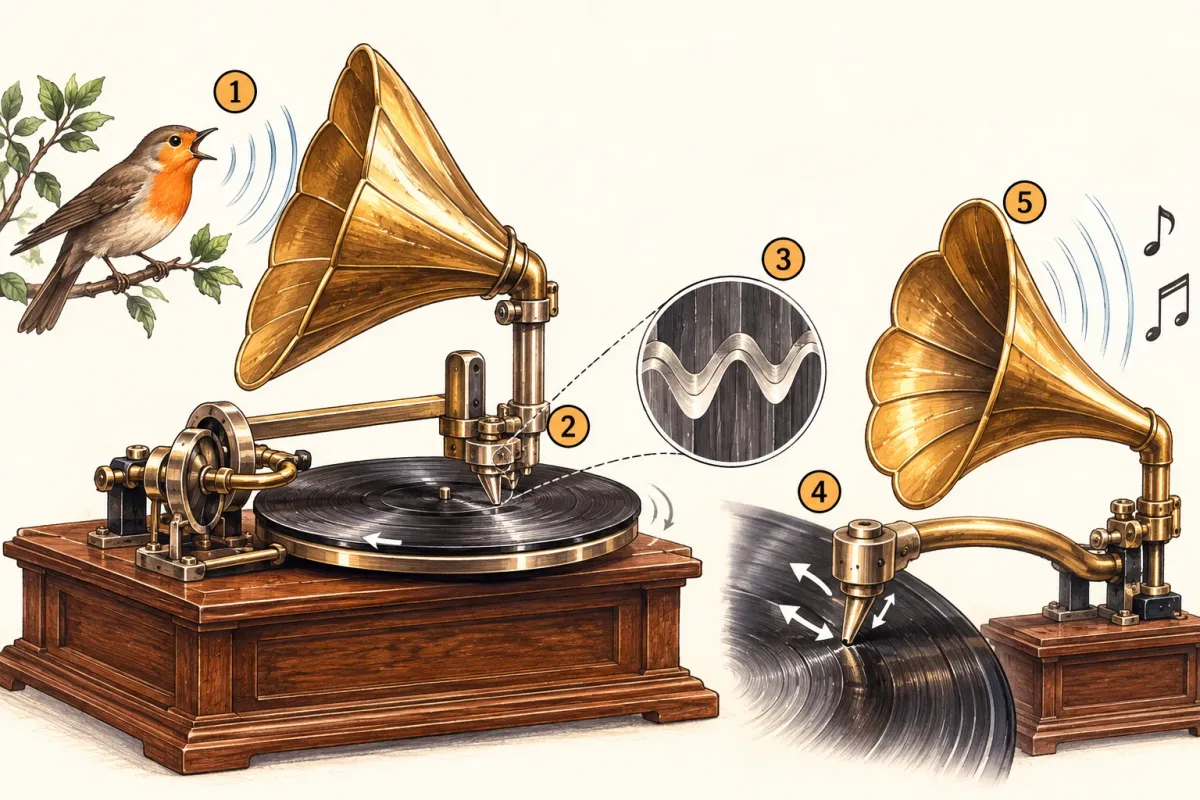
- Sound goes into a big horn (here a singing bird), which gathers it into its narrow end
- A thin membrane at the end vibrates and moves a cutting needle over the spinning wax disc
- Up close: the sound has become a wiggly groove
- On playback, a needle rides along the groove and wiggles with it
- The horn makes the vibration louder and sends it into the room
Rock, electric guitars and synthesizers
In the 1950s, rock and roll mixed blues, country and gospel with a strong beat, and the electric guitar became its voice. In the 1960s, inventors such as Robert Moog built synthesizers, machines that make sounds with electricity. Today, a laptop can be a whole recording studio.
Hip-hop, pop and today
Hip-hop began in the Bronx, in New York City, in the 1970s, with DJs who played the rhythmic parts of records and rappers who spoke rhymes over them. Today pop, rock, classical, electronic and music from all over the world can all be found in the same place, on your phone.
Hear the styles on this page
- Listen for the slow, bouncing long-short beat and the "blue" notes that slide up into the right note.
- Listen for the hand claps on beats 2 and 4, a call answered by a reply, and the "Amen" chords at the end.
- Listen to the left hand: a low note, then a chord, like a march, while the right-hand tune lands between the beats.
- Listen for the low notes only on beats 1 and 3, while the tune bounces long-short with plenty of surprises.
- Listen for the even, driving piano notes and the strong snare on beats 2 and 4.
- Listen for the "boom-chick": a low note, then a chord, and little notes that slide into the tune.
- Listen for the "boom" of the kick and the "bap" of the snare under a short piano loop that repeats.
- Listen for the four chords going round and a short, catchy tune you could sing back right away.
- Listen for one clashing chord hammered again and again, with loud accents that land where you do not expect them.
- Listen for the snare hitting hard on beats 2 and 4, and a short guitar riff that keeps coming back.
- Listen for machine-like patterns that repeat exactly, with clean electronic tones instead of real instruments.
How this page was checked: each fact was looked up again in the sources below — encyclopedias, museums, universities, cultural institutions and makers. Wikipedia was used only as a pointer, never as a source. It has not been reviewed by an outside music expert; if you spot a mistake, please tell us at support@sunsunlabs.com.
- Britannica: Claude Debussy
- Britannica: Impressionism (music)
- Britannica: Igor Stravinsky
- Britannica: The Rite of Spring
- Britannica: Jazz
- Britannica: Louis Armstrong
- Britannica: Phonograph
- The Met, Heilbrunn Timeline of Art History: Nineteenth-Century Classical Music
- Britannica: Rock and roll
- Britannica: Rock
- Britannica: Robert Moog
- Britannica: Hip-hop
Piano sound: Salamander Grand Piano by Alexander Holm (CC BY 3.0).